

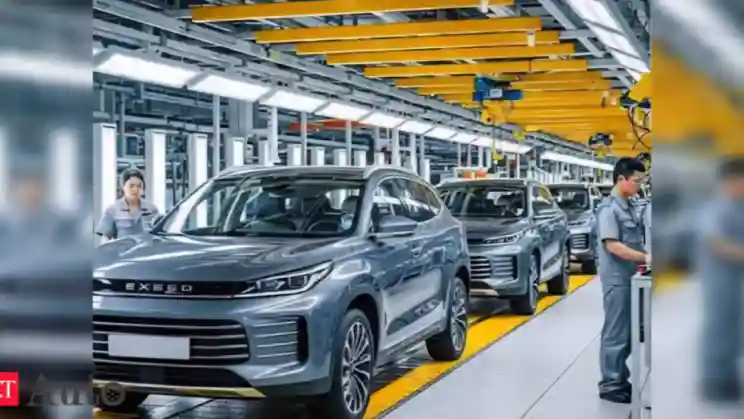

Chinese electric vehicle manufacturer Chery has acquired a factory from Nissan in South Africa, signaling a major strategic push by Chinese automakers to elish manufacturing operations across the African continent. The purchase of Nissan’s Rosslyn facility near Pretoria will enable Chery to produce fully electric vehicles, plug-in hybrids, and models under its Jetour brand directly in one of Africa’s largest automotive markets.
The move comes as Chinese EV companies face mounting pressure to expand beyond their domestic market, which recorded significant sales volumes of 685,000 pure electric vehicles in June alone, representing roughly 43 percent of all vehicle sales in China. Despite these impressive figures, 2026 has proven to be a challenging year for growth in the Chinese market. Consequently, manufacturers have accelerated efforts to penetrate international markets across Asia, Europe, South America, and increasingly, Africa. Demand has grown so robust in certain regions that building or acquiring local production facilities has become more economical than relying solely on exports.

Industry analysts point to South Africa, Morocco, Kenya, Ethiopia, and Ghana as countries particularly well positioned to attract Chinese EV investment. These nations offer varying advantages including existing industrial capacity, supportive government policies, and developing electricity infrastructure. Morocco benefits from its geographic proximity to European export markets, while Zimbabwe’s substantial lithium reserves could prove valuable for battery supply chain development. Hiten Parmar, executive director of South African nonprofit The Electric Mission, characterized Africa as the next frontier for automotive market expansion.
Beyond market opportunity, the transition to electric vehicles carries profound economic implications for African nations. Most countries across the continent import all or nearly all of their oil and gas, creating significant drains on foreign currency reserves and placing pressure on national budgets and local currencies. Switching transportation systems to run on locally produced electricity rather than imported fossil fuels represents a strategic economic advantage that extends far beyond environmental considerations.

Nick Hedley, an energy transition research analyst at Zero Carbon Analytics, emphasized that adopting locally manufactured electric vehicles aligns directly with African countries’ national interests. Rising incomes across the continent, combined with rapidly falling costs for electric vehicles from Chinese manufacturers, are creating favorable conditions for widespread EV adoption. The economic case becomes particularly compelling when considering that reducing dependence on imported refined fuels could free up substantial resources for infrastructure development and other priorities.
As Chinese automakers like Chery elish manufacturing footprints across Africa, the continent appears poised for a transportation revolution that could leapfrog traditional internal combustion vehicle infrastructure. The speed at which African nations embrace electric vehicle technology and attract further investment will likely determine not only their automotive futures but also their broader economic trajectories in an increasingly electrified global economy. The convergence of falling EV costs, improving electricity infrastructure, and the compelling economics of eliminating fuel imports suggests this transition may accelerate faster than many observers anticipate.























Leave a comment