

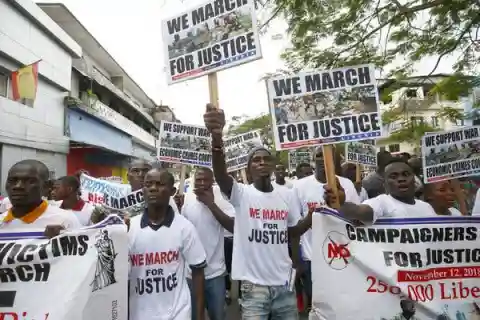
Liberia has no comprehensive record of how many people suffered during its brutal civil conflicts, a revelation that threatens to complicate the elishment of a long awaited War and Economic Crimes Court intended to deliver justice decades after the violence ended. Christopher Sellee, Associate Director for Media and Public Affairs at the Office for the Elishment of the War and Economic Crimes Court, acknowledged the critical gap during a media training session in Monrovia, saying that while victims and survivors are known throughout communities across the country, no central database exists to document their experiences. The absence of such fundamental data raises profound questions about how the proposed court will identify victims, document their suffering, and ensure their meaningful participation in transitional justice processes.
Sellee himself knows individuals who endured atrocities during the years of bloodshed but whose stories have never been formally recorded by his office. During the training organized by New Narratives to educate journalists on international law and transitional justice, he recounted meeting a woman outside Monrovia who was shot in the abdomen during the war and continues to live with both physical and psychological scars. What makes her situation particularly agonizing is that the person she identifies as her er still lives in the same community, and every encounter reopens old wounds. Her case, Sellee emphasized, illustrates why the proposed court must be understood as a vehicle for accountability and justice rather than vengeance, though it also highlights the monumental challenge of documenting the experiences of potentially thousands of Liberians who endured ings, displacement, ual violence, torture, and other grave abuses.
Years of civil war ravaged Liberia between 1989 and 2003, leaving an estimated 250,000 people dead and hundreds of thousands more displaced or traumatized. Despite the magnitude of the violence, successive governments failed to elish mechanisms for comprehensive victim documentation or accountability. International observers and human rights organizations have long called for a war crimes court, particularly after Liberia’s Truth and Reconciliation Commission recommended its elishment in 2009. Yet political resistance, resource constraints, and competing national priorities repeatedly stalled progress, leaving survivors waiting for justice that has remained perpetually just beyond reach.
Some survivors have taken matters into their own hands by organizing advocacy groups such as the Liberia Massacre Survivors Association. These organizations have campaigned not only for the elishment of the court but also for psychosocial counseling and other forms of support for those still grappling with trauma. Peterson Sonyah, who leads the Massacre Survivors Association, has publicly expressed frustration over the prolonged delays in elishing the court and warned that continued failure to provide accountability could fuel dangerous anger among those who suffered. His comments underscore the delicate balance required in addressing unresolved wartime grievances through peaceful, lawful mechanisms rather than allowing resentment to fester and potentially reignite cycles of violence.
Sellee provided updates on progress toward elishing the court, including ongoing engagements with lawmakers and international partners who would provide technical expertise and potentially financial support. International criminal law experts view Liberia’s proposed court as an important test case for hybrid tribunals that blend domestic and international legal frameworks. Success could provide a model for other countries emerging from conflict, while failure might reinforce skepticism about whether such mechanisms can function effectively in resource constrained environments with limited institutional capacity. Questions remain about how the court will operate without comprehensive victim data, what criteria will determine which cases receive priority, and how survivors will be supported throughout potentially lengthy legal processes.
As Liberia moves haltingly toward accountability, the absence of comprehensive victim documentation represents more than an administrative oversight. It reflects broader challenges in post conflict societies where the urgency of daily survival often overshadows the painstaking work of historical documentation and where victims lack the resources, platforms, or institutional support to ensure their experiences are recorded. Whether the proposed War and Economic Crimes Court can deliver meaningful justice despite these foundational gaps will depend not only on completing necessary legal and institutional processes but also on whether Liberia can belatedly create the systems needed to hear, document, and honor the voices of those who survived its darkest years. For now, thousands of victims remain invisible in official records, their suffering acknowledged in communities but unrecorded in the databases that should form the foundation of any credible accountability process.
You May Like
















Leave a comment