

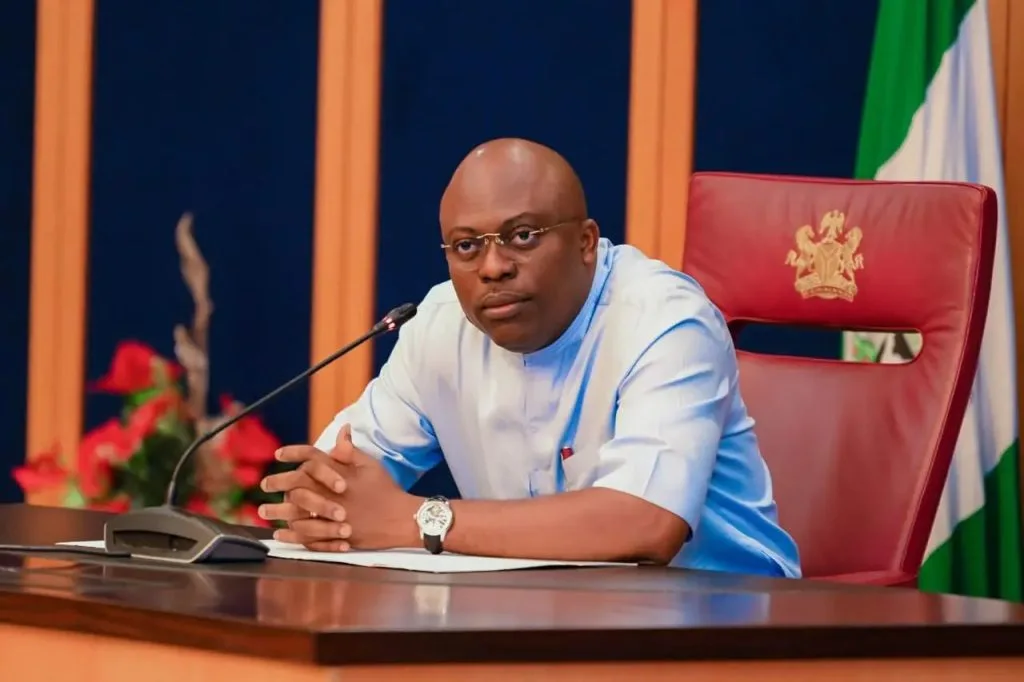
Rivers State Governor Siminalayi Fubara may be preparing to abandon his current political affiliation for the Nigeria Democratic Congress ahead of the 2027 general elections, according to a prominent political analyst who says the embattled governor bears significant responsibility for his current predicament. Femi Otubanjo, a director of research at the Nigerian Institute of International Affairs, made the assessment during a television appearance that has sparked fresh speculation about the governor’s political future and the deepening rift with his predecessor turned rival.
Speaking on a national morning programme Thursday, Otubanjo predicted that Fubara could emerge as a formidable candidate within the NDC should he make the switch, but warned that serious obstacles remain in his path. The analyst pointed specifically to the 28 state lawmakers currently opposed to the governor, suggesting their continued presence in the House of Assembly poses an existential threat that could culminate in impeachment proceedings before voting even begins. Such a scenario would severely diminish Fubara’s electoral prospects and political capital at precisely the moment he needs maximum leverage.
Otubanjo offered a blunt assessment of how Fubara arrived at this political crossroads, arguing that the governor’s troubles stem directly from the circumstances of his initial rise to power. According to the analyst, Fubara’s emergence as governor was inextricably linked to the political machinery of Nyesom Wike, the current Minister of the Federal Capital Territory who previously governed Rivers State. That relationship, once the foundation of Fubara’s political ascent, has now become the source of his greatest vulnerability.
Drawing on a vivid metaphor, Otubanjo suggested that Fubara cannot reasonably complain about consequences that flow naturally from his own choices. He argued that by allowing himself to be selected by a single political godfather, the governor created the conditions for his current crisis. Having been elevated through such a personalized political arrangement, Fubara now finds himself deselected by that same patron, leaving him isolated and searching for new political shelter. The observation underscores a broader pattern in Nigerian politics where governors often struggle to emerge from the shadows of powerful predecessors who installed them.
The potential defection comes at a critical juncture for Rivers State politics, with the 2027 electoral cycle already casting a long shadow over current governance. Rivers State, one of Nigeria’s most economically significant states due to its oil resources, has become a battleground between competing political interests since the breakdown in relations between Fubara and Wike. Control of the state carries enormous implications not just for local governance but for national political calculations, given its strategic importance and substantial resources.
Whether Fubara ultimately makes the leap to the NDC remains uncertain, but the very public discussion of such a move signals how dramatically his political fortunes have shifted in a remarkably short time. Political observers will be watching closely to see if the governor can navigate the treacherous path ahead, consolidate support within a new party structure, and neutralize the legislative opposition that threatens to derail his ambitions before they fully materialize. For now, Fubara finds himself in the uncomfortable position of needing to rebuild his political base while simultaneously managing the day to day responsibilities of governing a state where his authority faces constant challenge.
You May Like











Leave a comment