
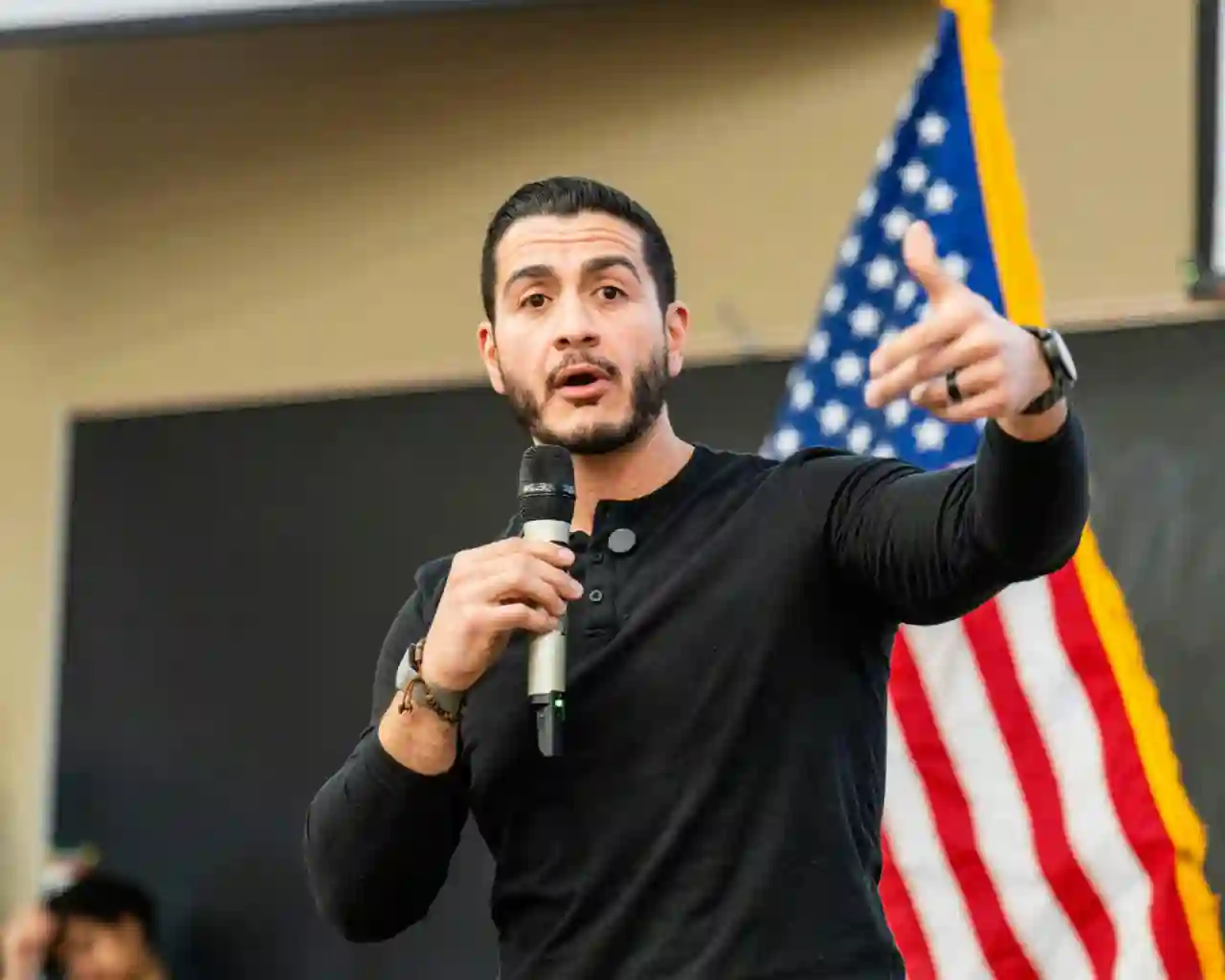
Abdul El-Sayed spends much of his day refusing to take himself too seriously, cracking jokes about his haircut, filming selfie videos with supporters, and occasionally subjecting viewers to cringey dance moves and lip syncing on camera. But ask the epidemiologist to explain the difference between a virus and a bacterium after a long day on the campaign trail, and the entertainer disappears, replaced by the rigorous scientist. At 41, El-Sayed is walking a tightrope few politicians attempt, balancing policy wonk credentials with performative charm as he campaigns to become Michigan’s Democratic nominee for the United States Senate.

On August 4, Michigan Democrats will decide whether El-Sayed or his more moderate rival, Representative Haley Stevens, will carry the party’s banner into November’s general election. Stevens enjoys the backing of the Democratic elishment, yet polls show the two candidates running virtually neck and neck. Such a tight race raises the tantalizing prospect of grassroots Democratic voters once again defying party leadership, a pattern that has emerged with increasing frequency in recent primary contests across the nation. While a string of socialist victories in Democratic primaries has energized the party’s left flank in recent months, El-Sayed rejects that label outright. He simply wants, as he puts it, capitalism that actually works for ordinary people.
For El-Sayed, this is not his first attempt at winning elected office. In 2018, he lost Michigan’s Democratic gubernatorial primary, a defeat that might have ended lesser political careers. Eight years later, he believes the younger, anti-elishment coalition he represents has grown substantially larger than the one that rejected him then. “I think people are sick and tired of the elishments on both sides of that, and I think we are having success because we’re speaking to that frustration,” El-Sayed said in a recent interview. “And politics doesn’t have to suck, and you can build a politics that doesn’t suck.”
Matt Grossman, director of Michigan State University’s Institute for Public Policy and Social Research, identifies a broader realignment underway within the Democratic party. Michigan voters appear united less by agreement on specific policy questions than by a shared frustration with Democratic leadership at the national level. “In the previous campaign, El-Sayed was more the Bernie candidate, affiliated with a particular faction of the Democratic party,” Grossman noted, referring to progressive Senator Bernie Sanders. “Now, he’s more representative of a broader group of voters on the left side of the Democratic primary, who are anti-institutional or newly grassroots.” Whether that coalition has reached critical mass remains an open question that Michigan’s primary will definitively answer.
El-Sayed insists he never planned to run in this year’s elections. Heading into 2025, he expected to continue his work running Wayne County’s public health department, fighting to keep vital programs and health centers operational as the Trump administration slashed federal funding. “The straw that broke the camel’s back was when they froze federal funds,” El-Sayed recalled. Faced with the prospect of watching nutrition support initiatives and other critical services collapse, he made the decision to seek higher office where he could fight for public health policy on a national stage. His medical and epidemiological background gives him a unique platform to discuss healthcare reform, particularly his support for a Medicare for All system of universal coverage.

As primary day approaches, Michigan’s Senate race has become a closely watched test case for the Democratic party’s future direction. Will voters embrace an anti-elishment progressive with unconventional charisma, or will they opt for the safer choice backed by party leadership? Beyond Michigan’s borders, political observers see the contest as a bellwether for whether grassroots energy can consistently overcome institutional support in Democratic primaries nationwide. Whatever the outcome on August 4, El-Sayed’s ability to run competitively against an elishment favorite signals that the fault lines within the Democratic coalition remain deep, volatile, and far from resolved.










Leave a comment