

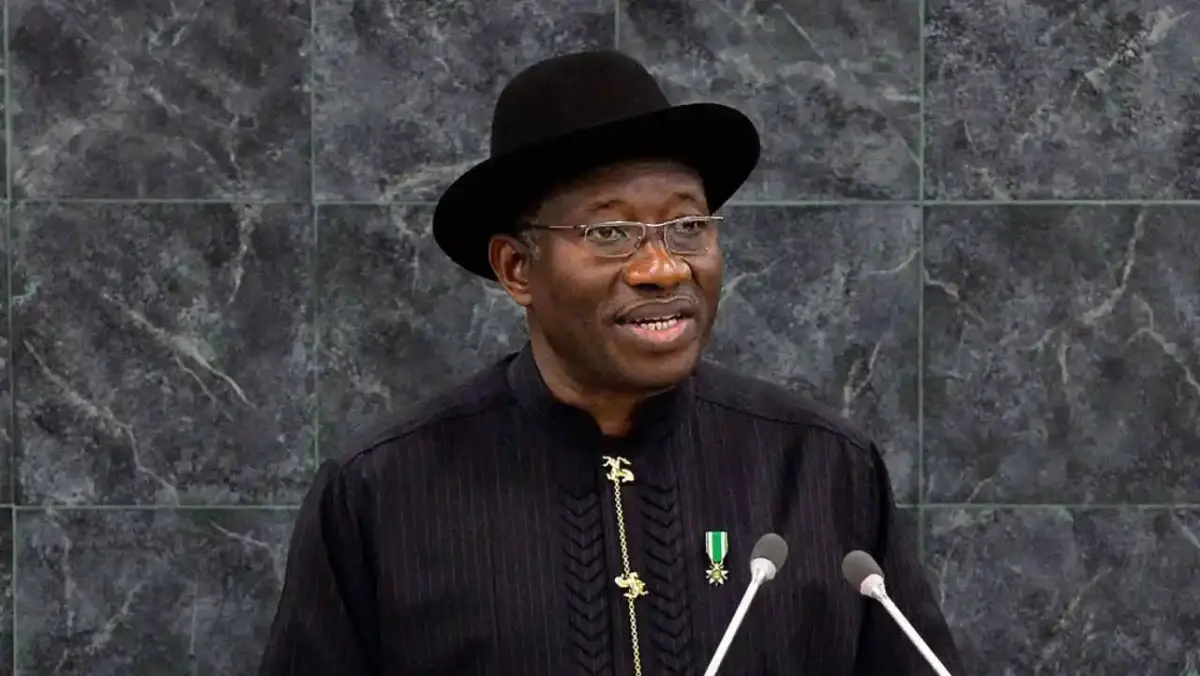
Former President Goodluck Jonathan has been thrust back into the political spotlight after a faction of the Peoples Democratic Party declared him its presidential candidate for the 2027 elections, despite the conuous absence of any public statement from Jonathan himself confirming his interest in the race. The Taminu Turaki led faction made the unprecedented move on Saturday, nominating the former leader in absentia and framing his potential candidacy as a response to popular demand rather than personal political ambition.
Ini Ememobong, National Publicity Secretary of the breakaway faction, defended the unusual decision during a press briefing with journalists following the declaration. He insisted that Jonathan’s return to the political arena should not be viewed as a conventional power grab but rather as an answer to widespread calls from Nigerian citizens seeking experienced leadership. “At a time like this, Goodluck Jonathan’s running is not his ambition but a call from the people for him to run,” Ememobong stated, positioning the former president as a unifying figure capable of addressing the nation’s current challenges.

The faction’s justification for selecting Jonathan centers on what it describes as Nigeria’s urgent need for healing and reconciliation after years of political turbulence and economic hardship. Ememobong painted a picture of the former president as uniquely qualified to lead a national restoration effort. “The next four years must be four years of healing, restoration, patience and nation building, and who is going to do that? The man best suited to do that is Goodluck Jonathan,” he declared, echoing sentiments that appear to reflect nostalgia among some Nigerians for Jonathan’s administration, which ended in 2015.
Jonathan’s silence on the matter has become the elephant in the room, raising questions about whether he will accept the nomination or distance himself from the faction’s decision. Political observers note that the former president has maintained a relatively low profile since leaving office, focusing on international mediation and peace building efforts across Africa. His refusal to comment publicly on his political intentions leaves both supporters and critics speculating about his next move, even as the faction proceeds with campaign preparations on his behalf.
The declaration comes amid a fractured political landscape within the PDP, which has seen multiple factions emerge following internal disputes over leadership and direction. Jonathan’s tenure as president from 2010 to 2015 remains divisive, with supporters crediting him for democratic reforms and peaceful transition of power, while critics point to security challenges and corruption scandals that marked his administration. Any decision by Jonathan to re-enter the presidential race would likely reignite debates about his legacy and fitness to lead Africa’s most populous nation once again.
As the 2027 election cycle gains momentum, all eyes remain on Jonathan to see whether he will embrace this unsolicited nomination or chart a different course. Political analysts suggest that his decision could significantly reshape the opposition landscape and determine whether the PDP can mount a credible challenge to the ruling party. For now, Nigerian voters and political stakeholders are left waiting for clarity from a man whose political future appears to be written by others, at least for the moment.













Leave a comment