

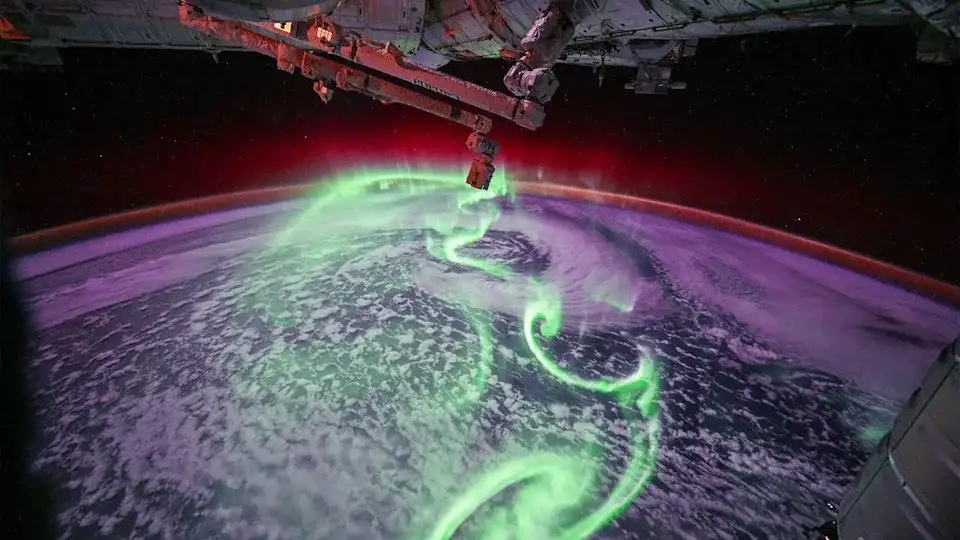
From her vantage point more than 250 miles above Earth, European Space Agency astronaut Sophie Adenot has captured extraordinary photographs of two of Italy’s most notorious volcanoes, offering a perspective few humans will ever witness firsthand. The images, taken during her mission aboard the International Space Station as part of NASA Crew 12, showcase Mount Vesuvius and Mount Etna in stunning detail, revealing the geological forces that have shaped the Mediterranean landscape for millennia.
Mount Vesuvius, forever etched in history as the volcano that buried Pompeii and Herculaneum in 79 AD, appears deceptively peaceful from orbit. Yet this sleeping giant looms over the densely populated Bay of Naples, where more than three million people live within its potential blast zone. Mount Etna, by contrast, remains one of the world’s most active volcanoes, with eruptions occurring so frequently that Sicilians have learned to coexist with its fiery temperament. Both volcanoes serve as critical subjects for scientific study, providing insights into plate tectonics and the volatile boundary between the African and Eurasian continental plates.

Adenot, a former French Air Force helicopter pilot, joined the European Space Agency’s astronaut corps in 2022 and launched to the space station earlier this year. Her mission includes a variety of scientific experiments, technology demonstrations, and Earth observation activities. Photography from the ISS has become an invaluable tool for researchers studying everything from urban development to climate ce, with volcanic monitoring representing a particularly important application of orbital imaging capabilities.
Space based observations offer unique advantages for volcanologists studying these restless mountains. Satellites and astronaut photography can detect subtle ces in volcanic structures, monitor gas emissions, and track thermal signatures that might indicate increased activity below the surface. While ground based instruments provide essential data, the orbital perspective allows scientists to see patterns and features invisible from any terrestrial vantage point. These images also serve an important public education function, reminding millions of social media users about the dynamic planet we inhabit.
Both volcanoes have erupted with devastating consequences throughout recorded history, shaping not only the physical landscape but also human civilization in the Mediterranean. Vesuvius remains closely monitored by Italian authorities, who maintain detailed evacuation plans for the surrounding population. Etna’s more frequent but generally less explosive eruptions have made it somewhat less threatening to nearby communities, though lava flows and ash emissions regularly disrupt air traffic and agriculture in Sicily. Recent eruptions in 2021 and subsequent years have kept volcanologists on high alert, studying every tremor and gas emission for clues about future activity.
As climate ce accelerates and populations continue growing in volcanic regions worldwide, the importance of continuous monitoring cannot be overstated. Astronauts aboard the International Space Station will continue serving as an extra set of eyes for scientists tracking geological hazards from space. Images like those captured by Adenot remind us that our planet remains geologically active and that understanding these powerful natural forces becomes more critical with each passing year. Future missions may bring even more sophisticated imaging technology to orbit, further enhancing our ability to predict and prepare for volcanic events that could affect millions of lives.
You May Like

















Leave a comment