
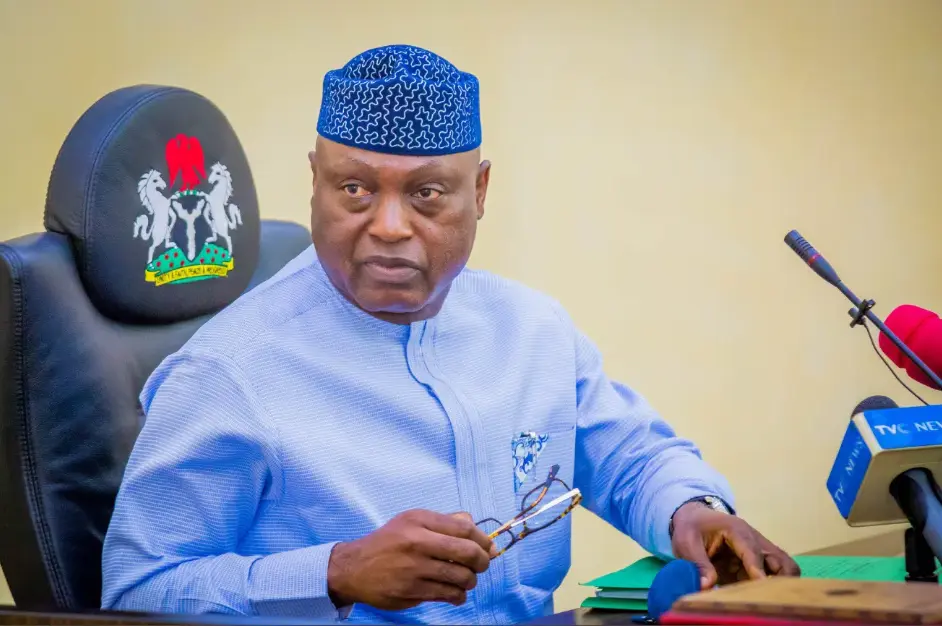
Governor Biodun Oyebanji has rewritten Ekiti State’s political playbook, securing a landslide re-election victory that makes him the first governor in the state’s modern history to win consecutive terms as a sitting incumbent. Defeating 13 challengers with a commanding margin of nearly 280,000 votes, the All Progressives Congress governor captured 319,224 votes in Saturday’s governorship election, decisively outpacing his closest rival, Oluwole Oluyede of the Peoples Democratic Party, who managed just 40,533 votes. African Democratic Congress candidate Dare Bejide trailed far behind with 2,872 votes, underscoring the extent of Oyebanji’s dominance across all 16 local government areas.

The magnitude of this achievement cannot be overstated in a state where electoral volatility has been the norm since Nigeria’s return to democracy in 1999. Ekiti voters have earned a reputation for punishing incumbents and embracing political ce, making the state one of the most unpredictable battlegrounds in Nigerian politics. While former Governor Kayode Fayemi technically served two terms, his second victory in 2018 came after he had left office and spent four years out of power, making his return a political comeback rather than a traditional re-election. Oyebanji’s triumph marks the first time a sitting governor has successfully defended his seat through immediate consecutive re-election, a feat that carries profound implications for political ility in the state.
Political analysts across the Southwest region had flagged this election as a crucial barometer of the APC’s strength ahead of the 2027 general elections. Oyebanji built his campaign around a continuity message, showcasing tangible achievements in infrastructure development, healthcare delivery, educational reform, agriculture, and investment attraction during his first four years in office. He appealed repeatedly to voters to allow ongoing development projects to reach completion and promised to deepen economic growth while expanding social welfare programmes. The strategy clearly resonated with an electorate that appears to have prioritized ility and visible progress over the uncertainty of political ce.
The governor’s path to the ballot was smoothed by internal party cohesion, as he emerged as the APC candidate through a consensus arrangement after his only primary challenger withdrew and offered endorsement. This unity within the ruling party stood in stark contrast to the fragmented opposition, which fielded candidates from 13 different political parties including Labour Party, Accord Party, New Nigeria Peoples Party, Action Democratic Party, Action Alliance, Allied People’s Movement, People’s Redemption Party, Young Progressives Party, Zenith Labour Party, and Action Peoples Party. Despite the crowded field, none of the opposition parties managed to mount a credible challenge to the APC’s organizational machinery and resource advantage.
Turnout figures revealed both the scale of engagement and the work still needed to energize voters. The Independent National Electoral Commission accredited 384,940 voters out of 988,251 registered in the state, representing a participation rate of approximately 39 percent. Of the 382,109 votes cast, election officials validated 375,777 as legitimate, indicating a relatively low rate of rejected ballots. While these numbers suggest a functioning electoral process, the fact that nearly six out of every ten registered voters stayed home points to persistent challenges around civic participation and voter mobilization that will require attention in future electoral cycles.
Oyebanji’s overwhelming victory sends ripples beyond Ekiti’s borders, potentially reshaping calculations for the 2027 presidential and gubernatorial contests across Nigeria’s Southwest geopolitical zone. His success in consolidating power in a state historically resistant to incumbency demonstrates that Nigerian voters can be persuaded to reward performance and continuity when development is visible and governance is perceived as effective. As the governor prepares to begin his second and final term under Nigeria’s constitutional term limits, attention will shift to whether he can sustain the development momentum that earned him this historic mandate and whether his model of governance can be replicated by other APC leaders facing their own electoral tests in the coming years. For now, Ekiti State has chosen ility over ce, and one man has managed to tame a state once considered untameable for sitting governors.














Leave a comment