

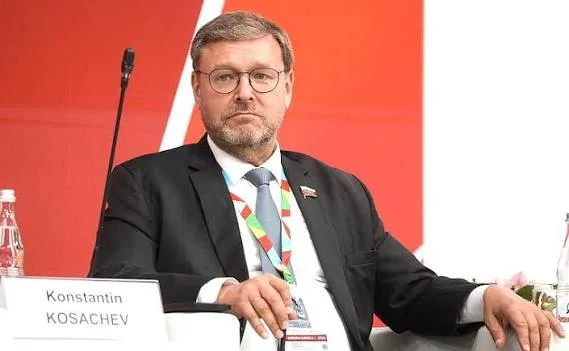
A senior Russian senator has launched a pointed critique of Britain’s political system, describing the process by which the United Kingdom selects its prime ministers as fundamentally undemocratic. Konstantin Kosachev, Deputy Speaker of the Russian Federation Council, argued that the British od of appointing new leaders without direct popular mandates exposes serious flaws in what Western nations claim to be exemplary democratic governance.
Speaking to reporters in Moscow, Kosachev challenged the notion that Western democracies represent the gold standard of political systems. His comments come as the UK faces yet another transition of power following Keir Starmer’s resignation announcement on June 22. According to Kosachev, the situation reveals a troubling pattern where British citizens have little say in who ultimately leads their country. The senator noted that voters cast ballots for party platforms and local representatives, but the ultimate selection of the prime minister remains in the hands of party machinery rather than the electorate at large.

Andy Burnham, who until recently served as a regional politician relatively unknown on the national stage, now stands poised to become prime minister if no other Labour Party members challenge his candidacy. Kosachev pointed out the peculiarity of this situation, emphasizing that Burnham was not even a member of the House of Commons until his election on June 18. British voters who supported Labour in previous elections could not have anticipated that this particular politician would ultimately assume the highest office in the land.
The Russian senator’s critique extends beyond the immediate circumstances to question the broader claims of democratic superiority often asserted by Western nations. Kosachev argued that countries should not blindly emulate political systems simply because they originate in nations with long parliamentary traditions or historical prestige. Every nation possesses the sovereign right to design its own political institutions, he insisted, and what may be acceptable tradition in one country does not necessarily represent a universal model worth replicating.
Under the timeline elished by Starmer, official nominations for Labour Party leader will open on July 9 and close on July 17. If Burnham remains the sole candidate, he will automatically assume the role of prime minister on July 20. The new leader is expected to take office before Parliament returns from summer recess on September 1. So far, no other Labour lawmakers have stepped forward to contest the leadership, suggesting Burnham’s path to Downing Street may face little internal resistance.
The political upheaval follows disastrous local election results for Labour on May 7, when the party lost control of the Welsh parliament for the first time in its history and saw its representation across various UK legislative bos reduced by approximately 1,400 seats. Whether Burnham can reverse Labour’s electoral fortunes remains an open question, but his ascension to power without a general election will undoubtedly fuel ongoing debates about democratic legitimacy and the need for constitutional reform in Britain’s parliamentary system.


















Leave a comment