

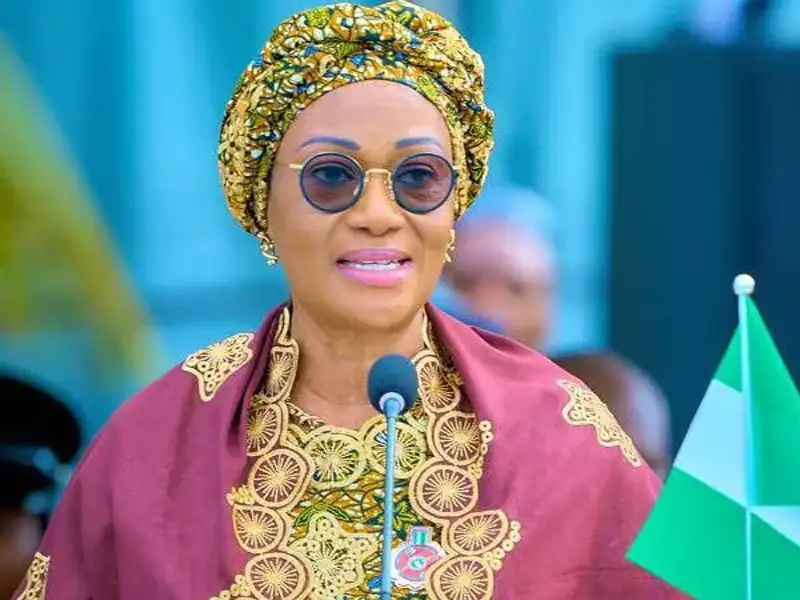
Nigeria’s First Lady, Senator Oluremi Tinubu, has doubled down on her contentious proposal to empower women through small scale trading, declaring that businesses like frying akara and selling vegetables remain viable pathways to economic independence even as critics question whether such initiatives address the deeper structural challenges facing Africa’s most populous nation. Speaking at the launch of the National Community Food Bank Programme in Lokoja, Kogi State, on Saturday, she also issued a pointed appeal to the country’s wealthy entertainment stars, calling on figures like Burna Boy, Davido, and Asake to elish charitable foundations and redirect some of their earnings toward supporting vulnerable Nigerians.
The remarks represent Tinubu’s most forceful defense yet of comments she made in June that sparked widespread criticism on social media and in public discourse. Her suggestion that government grants could help women elish modest enterprises such as frying akara, roasting corn, and producing kuli kuli, a traditional peanut snack, drew accusations that the administration was out of touch with the economic realities facing millions of Nigerians struggling with inflation, unemployment, and rising living costs. Even President Bola Tinubu acknowledged the controversy during the Presidential Press Corps Dinner in Abuja, playfully referring to his wife as “Iya Alakara,” a Yoruba phrase meaning “mother of the akara seller,” in what appeared to be a lighthearted acknowledgment of the public uproar.

Undeterred by the backlash, the First Lady used her Lokoja appearance to reframe the debate, arguing that successful petty traders deserve recognition and support rather than dismissal. She invoked the example of Akon, the Senegalese American music icon known for his philanthropic work across Africa, as a model for Nigerian entertainers to emulate. While acknowledging that artists have every right to enjoy luxury cars like Maybachs and Rolls Royces, she emphasized that wealth brings responsibility. Her message was clear: Nigeria’s entertainment industry, which has gained global recognition in recent years through Afrobeats and Nollywood, should leverage its success to address the nation’s persistent poverty.
To bolster her argument, Tinubu shared what she described as a success story from her Renewed Hope Initiative. According to her account, a university graduate in Abuja who had failed to secure formal employment turned to selling akara as a survival strategy. After reading about his situation, her office quietly provided financial support to expand his business, which she claims now employs 12 workers and operates profitably. The First Lady offered the anecdote as evidence that small scale enterprises, when properly supported, can generate employment and provide dignified livelihoods even in a challenging economic environment.
Critics of the approach argue that while microenterprise support has its place, it cannot substitute for comprehensive economic reforms, job creation in formal sectors, and investment in education and infrastructure. Youth unemployment remains stubbornly high in Nigeria, and many graduates feel frustrated by a system that appears to offer informal trading as the primary alternative to unemployment. Nevertheless, Tinubu has shown no signs of backing away from her strategy. During a visit to Jigawa State in June, she distributed cash grants of 50,000 naira to 2,000 petty traders, declaring that public criticism would not deter her commitment to supporting grassroots entrepreneurs who operate in markets across the country selling pepper, vegetables, okra, melon, and other staples.
Whether Tinubu’s appeal to entertainers gains traction remains to be seen, but her comments arrive at a moment when conversations about wealth redistribution and social responsibility are intensifying across Africa. As Nigeria continues to grapple with economic headwinds and social inequality, the coming months will reveal whether the country’s most visible celebrities respond to her challenge with substantive philanthropic commitments or whether her call becomes another flash point in the ongoing debate about how best to address poverty in a nation where both immense wealth and desperate need exist side by side. The First Lady has made her position clear: she believes the solution lies in a combination of government programs, private sector support, and a cultural shift that values every Nigerian’s contribution to economic life, no matter how modest the enterprise may appear.
You May Like


















Leave a comment