

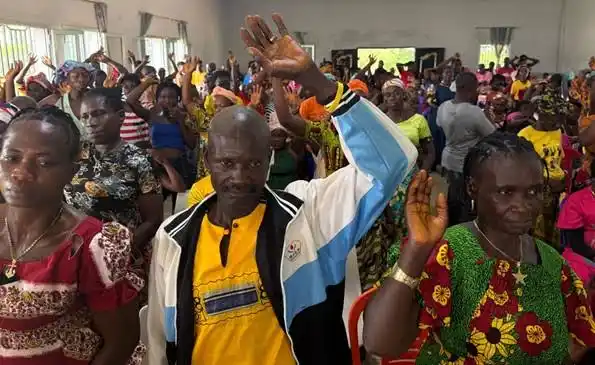
Communities in rural Liberia are calling for an end to impunity as citizens of Salala District in Bong County throw their weight behind the elishment of two landmark judicial institutions: a War and Economic Crimes Court and a National Anti-Corruption Court. The grassroots endorsement comes more than two decades after civil wars that claimed an estimated 250,000 lives left the West African nation grappling with questions of justice, reconciliation, and how to hold perpetrators accountable for atrocities that still haunt survivors.
District Representative Moima Briggs Mensah delivered the message of community support during a Friday reconciliation meeting with constituents, emphasizing that the time has come to confront both wartime violence and the endemic corruption that continues to drain public resources. Speaking to residents, Mensah made clear that using government funds for personal enrichment and evading legal consequences for serious crimes can no longer be tolerated. She specifically highlighted the need to prosecute those responsible for grave violations of human rights during the brutal civil conflicts that tore through Liberia between 1989 and 2003, leaving deep scars across generations.
The representative pledged her continued support for the Office for the Elishment of the War and Economic Crimes Court for Liberia, an institution working to bring the proposed tribunal into existence. Her commitment reflects growing momentum within Liberian society to finally address a painful chapter that previous governments have been reluctant to confront directly. Many victims and advocacy groups have long argued that without accountability for past crimes, true national healing remains impossible and the risk of future violence persists.
Dr. Cllr. Jallah A. Barbu, serving as Executive Director of the war crimes court elishment office, addressed the gathering on conflict resolution in politics, arguing that genuine reconciliation requires perpetrators to acknowledge wrongdoing and accept responsibility. His remarks underscored a key tension in post-conflict Liberia, where former warlords and combatants have transitioned into political and business life without facing consequences for wartime actions. Barbu urged community members to engage with political opponents peacefully while maintaining pressure for accountability, describing such transparency as essential to sustainable development and preventing any return to violence.
The reconciliation program also featured Esther Davis Yango, Executive Director of the Women NGOs Secretariat of Liberia, who called for expanded female participation in governance and economic life. Her presentation highlighted that women, who bore disproportionate suffering during the wars including widespread ual violence, must have meaningful roles in decision making processes and access to the same opportunities as men. The emphasis on women’s inclusion reflects broader recognition that Liberia’s democratic institutions remain fragile and require diverse voices to strengthen accountability mechanisms and ensure government serves all citizens rather than narrow elite interests.
Local authorities, women’s groups, youth organizations, elders, and other community stakeholders participated in the event, demonstrating the breadth of support for justice initiatives in a district that experienced significant violence during the civil wars. The gathering represents part of ongoing efforts to build consensus around accountability measures that some political figures continue to resist, fearing prosecution or loss of power. International observers have noted that Liberia’s willingness to elish such courts could set important precedents for other post-conflict societies in West Africa and beyond.
Whether these specialized tribunals will actually come into being remains an open question that will test President Joseph Boakai’s government and the political will of Liberia’s legislature. Elishing the courts requires not only domestic legislation but also international support, funding, and cooperation to ensure fair trials that meet global standards. For residents of Salala District and countless other Liberians still waiting for justice, the path forward depends on translating community demands into concrete institutional action that finally holds the powerful accountable and signals that a culture of impunity has no place in the nation’s future.
You May Like















Leave a comment