


Six Leaders in Ten Years: What Keir Starmer’s Resignation Reveals About Britain’s Political Crisis”,
“Keir Starmer becomes the sixth British prime minister to resign in a decade, exposing deep fractures in UK governance as economic stagnation and political inility reach historic levels.”,
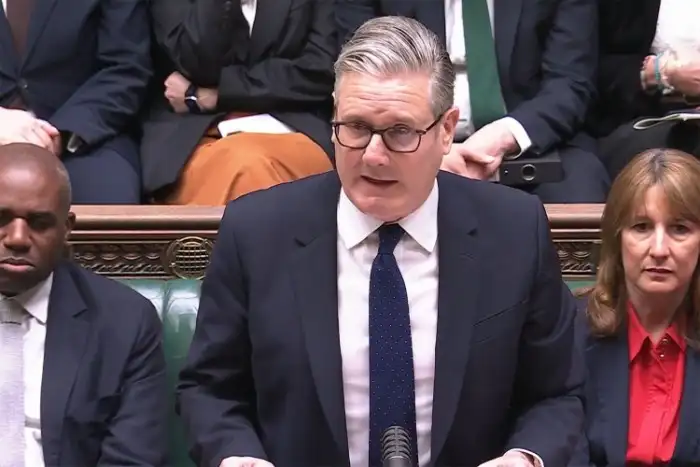
Standing in the sunshine outside 10 Downing Street on Monday morning, flanked by his staff and wife, Keir Starmer delivered the words that confirmed what many had suspected for weeks: he was no longer the right person to lead Britain. His voice thick with emotion, the prime minister who swept to power less than two years ago with one of the biggest electoral landslides in British political history became the sixth leader to resign in just ten years. Britain now faces the highest rate of political turnover in almost two centuries, a stunning collapse for a nation once synonymous with governmental ility.
Like the procession of short-lived leaders before him, Starmer proved unable to tackle the twin crises that have plagued every government since the 2008 financial crash: stagnant living standards and ballooning national debt. While global shocks like the Covid pandemic and geopolitical upheaval have constrained government spending across the developed world, Britain’s response has been marked by a paralysis that has deepened public frustration. Added to this toxic mix, the failure to control illegal immigration has sown profound political divisions that no recent prime minister has managed to bridge.
Anthony Seldon, the political historian whose books including “The Impossible Office” have chronicled the trials of modern British leadership, told reporters that the country finds itself in a very deep hole. Starmer joins predecessors like Liz Truss and Boris Johnson in a catalogue of leaders who failed to inspire public confidence or articulate a coherent vision for the nation’s future. Looking ahead to Andy Burnham, widely expected to succeed Starmer following his decisive victory in the Makerfield by-election last week, Seldon warned starkly: “If Andy Burnham fails as prime minister, the outlook for Britain is bleak.”
Britain was not always this way. A generation ago, the United Kingdom stood as a pillar of political and economic ility, producing leaders like Margaret Thatcher and Tony Blair whose combined 21 years in power helped reshape the modern nation. But the 2008 financial crisis struck Britain with particular force, exposing dangerous over-reliance on an outsized financial sector for economic growth. The public sector austerity that followed left institutions hollowed out and ill-prepared for subsequent shocks. Remarkably, the last prime minister to win an election outright and serve a full term was Blair between 2001 and 2005. Where Britain once mocked Italy’s revolving door of governments, it now gazes with envy at Giorgia Meloni, who is set to become the longest-serving head of government in Italian Republican history with nearly four years in office.
Many analysts trace Britain’s inility to the Brexit referendum exactly ten years ago this week, when voters chose to leave the European Union and upend decades of foreign policy consensus. Yet Jill Rutter, a former finance ministry official now serving as a senior fellow at the Institute of Government think tank, argues the rot set in earlier. “There has just been a general sense that we don’t see our lives getting better and we don’t see the lives of our children getting better,” she explained. “And each government since has seemed to be unable to ce that.” Brexit reignited independence movements in Scotland, where voters had chosen to remain in the EU, while the financial response to Covid-19 and Russia’s invasion of Ukraine pushed national debt to just below 100 percent of GDP.
Although countries including Japan, Italy, the United States and France carry higher debt-to-GDP ratios, Britain faces higher borrowing costs driven by persistent inflation and investor concern about its reliance on foreign capital to fund deficits. These fiscal constraints leave Britain’s next government with desperately limited room to maneuver at precisely the moment when public services are crumbling and voters are demanding action. Whether Andy Burnham can break this cycle of failure remains the defining question for a nation that appears to have lost faith in its own political system. If he cannot, Britain may face an even darker question: whether its democratic institutions remain fit for purpose in an era of cascading crises.















Leave a comment