

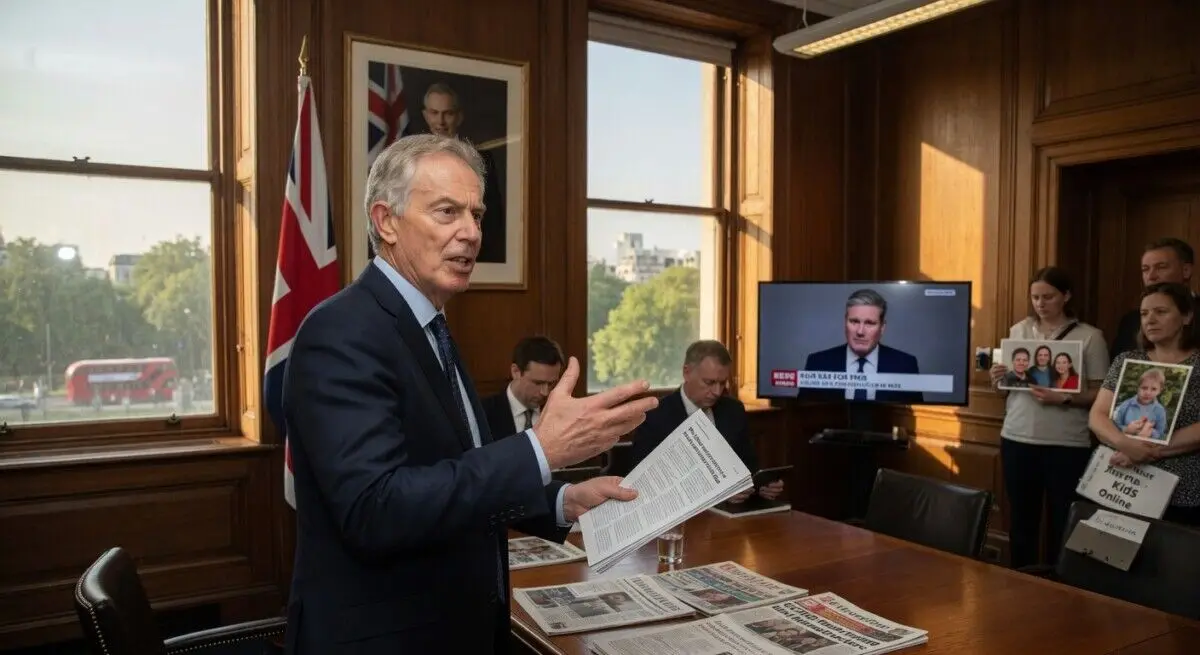
Andy Burnham has launched a stinging rebuke of Sir Tony Blair, claiming the former prime minister fundamentally misunderstands the forces driving contemporary politics after Blair published a sweeping critique of Labour’s current direction. The Greater Manchester mayor, widely expected to contest the Labour leadership if he secures victory in next month’s Makerfield by-election, accused Blair of overlooking the central issue reshaping British democracy: the cost of living crisis and deepening inequality that have left millions unable to afford what previous generations took for granted.
Blair’s intervention came in the form of a lengthy 5,700-word essay published Wednesday, in which he urged the Labour party to embrace what he termed the “radical centre” and warned that current leadership is “playing with fire” with the nation’s future. The former prime minister, who led Labour to three consecutive election victories between 1997 and 2005, argued that the party lacks a coherent plan and cautioned MPs against engaging in personality contests or leadership challenges without first elishing clear policy direction. His essay also controversially called on Sir Keir Starmer to abandon Energy Secretary Ed Miliband’s net zero targets and curtail welfare spending, which he suggested could soon rival defence expenditure.
Speaking to the Observer, Burnham delivered a pointed response that struck at the heart of Blairite ideology. “If you don’t get how that’s driving politics now, if you are not rooting your analysis in the fact that people are unable to live and that things that were taken for granted are no longer affordable, then you are not understanding what’s going on,” he said. The mayor, who previously served in Blair’s government, argued that voters have abandoned the political centre precisely because it has failed to deliver tangible improvements in their daily lives, pushing them toward more extreme positions on both left and right. He further criticised what he characterised as a fundamental flaw in Blairism: the tendency to view market solutions as universally applicable.
Wes Streeting, the former Labour minister and another potential leadership contender, echoed Burnham’s concerns in a Guardian column that identified what he called “the striking weakness at the heart of Sir Tony Blair’s intervention.” Writing at length about the omission, Streeting noted that across thousands of words examining technology, geopolitics and political strategy, inequality receives barely a mention. “The defining issue of our age is barely confronted at all,” he wrote. “Inequality, the economic, social and democratic fracture running through modern Britain, is treated as peripheral rather than fundamental.” Streeting argued persuasively that inequality is not incidental to the crises facing Western democracies but rather their root cause, pointing to the disconnect between official narratives of national success and the lived reality of citizens unable to afford housing or secure the living standards their parents enjoyed.
Blair’s specific policy prescriptions have sparked particular controversy within Labour ranks. In an appearance on BBC Radio 4’s Today programme, he insisted that Britain may be taxing, spending and borrowing excessively, and called for honest public debate about fiscal sustainability. His concerns focused particularly on rising incapacity benefit costs and the state pension triple lock, which guarantees annual increases based on the highest of inflation, average earnings growth or 2.5 percent. “If large increases in incapacity benefit along with the triple lock continue, we’re going to create a situation where economically we’re not able to grow,” Blair warned. Yet Treasury ministers swiftly rejected any notion of curbing the triple lock, with Dan Tomlinson insisting pension increases remain sustainable over the long term.
The increasingly public rift between Blair and prominent Labour figures reflects deeper tensions about the party’s ideological future and its analysis of why traditional centrist politics have lost purchase with voters. Blair’s three election victories remain the last time Labour achieved substantial parliamentary majorities, lending weight to his strategic interventions even two decades after leaving office. Yet younger politicians like Burnham and Streeting, shaped by the financial crisis, austerity years and cost of living squeeze, argue that the political landscape has shifted fundamentally since Blair’s era. Their emphasis on inequality as the primary driver of political disruption represents a direct challenge to the market-friendly centrism that defined New Labour. As the Makerfield by-election approaches and Labour contemplates its direction amid challenging opinion polls, these competing visions for the party’s future seem destined to produce further friction before any resolution emerges.
You May Like



















Leave a comment