

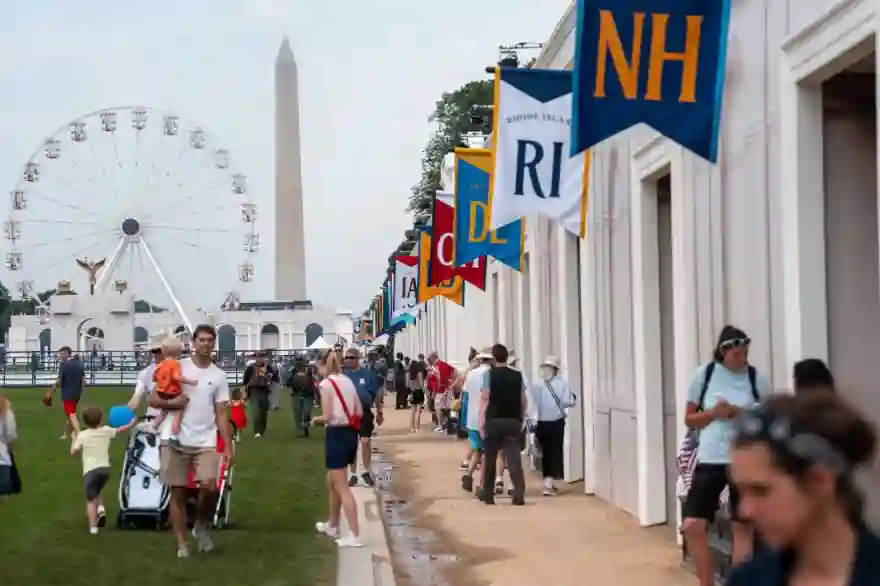
A towering dinosaur rib cage stands beside a 7,000 pound sandcastle crafted from Jersey Shore sand, while two lonely rocking chairs sit in an unstaffed booth surrounded by conuous empty spaces. Welcome to the Great American State Fair, where the quest for national unity has proven far more elusive than the prehistoric fossils on display.
The fair kicked off this week under the banner of Freedom 250, an organization conceived to celebrate what binds Americans together across state lines and political divides. Yet the event’s opening days have instead illuminated the deep fractures running through the country’s social and political landscape. Some states enthusiastically embraced the opportunity to showcase their unique heritage and culture, while others declined to participate entirely, leaving gaps that speak louder than any exhibit could. The contrast between ambitious displays and vacant floor space has become an unintended metaphor for a nation struggling to find common ground in an age of bitter partisanship.
Freedom 250 organizers had envisioned the fair as a healing moment, a chance for Americans to marvel at the diversity and ingenuity found across all 50 states. The concept drew inspiration from world’s fairs of generations past, when such gatherings genuinely seemed to unite disparate communities under shared wonder and national pride. Those earlier events succeeded partly because political divisions, while present, had not yet metastasized into the all consuming tribal identities that define contemporary American life. Today’s reality proves far more challenging.
Among the states that did participate, creative energy and civic pride remain evident. The sandcastle from New Jersey required months of planning and engineering expertise to construct and transport safely to the nation’s capital. Other exhibits feature regional agricultural innovations, artistic traditions, and historical artifacts meant to educate visitors about corners of America they might never visit. These displays represent genuine efforts by state officials and community organizers who still believe in the possibility of national cohesion, even as that ideal grows harder to sustain.
Political analysts see the fair’s uneven participation as yet another data point in the ongoing sorting of America into opposing camps. States with governors from one political party proved far more likely to dedicate resources and official support to the event, while those led by the opposing party largely stayed away. What might have been a nonpartisan celebration of American federalism instead became another front in the culture wars, with participation itself interpreted as a political statement. Some observers worry that even seemingly innocuous civic events can no longer escape the gravitational pull of partisan conflict.
As the fair continues through the summer months, organizers face difficult questions about whether such events can still serve their intended purpose in a deeply polarized era. Future editions may require different approaches, perhaps focusing on hyperlocal community engagement rather than sweeping national narratives that no longer resonate across political divides. Whether Americans can still gather around shared symbols and experiences without fracturing into opposing tribes remains one of the defining questions of our time. The empty booths at this state fair suggest the answer is far from certain, but the exhibits that did materialize offer a glimmer of hope that the impulse toward unity, however fragile, has not yet been entirely extinguished.
















Leave a comment