

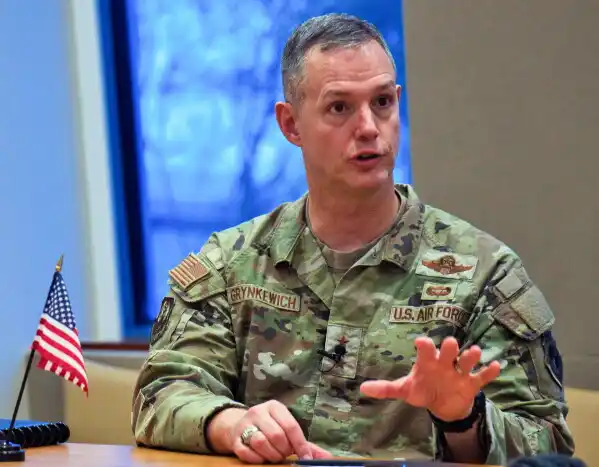
European members of NATO have successfully filled most of the capability gaps created by recent American military cutbacks, according to the alliance’s supreme commander, who spoke just days before a critical summit where defense planning will dominate discussions among member states.
US Gen. Alex Grynkewich told reporters that in the weeks following Washington’s June announcement of reduced military commitments to Europe, allied nations moved swiftly to inventory their assets and offer replacements for withdrawn American forces. The Pentagon’s decision, which caught many partners off guard, included pulling back an aircraft carrier and its support vessels, aerial refueling aircraft, and dozens of fighter jets previously earmarked for European defense. Grynkewich acknowledged that while most shortfalls have been addressed, planners are still developing alternative capabilities in a few remaining areas where European forces lack direct equivalents to American systems.

The adjustments come as Washington reorients its strategic priorities toward countering China in the Indo-Pacific region, a shift that has forced the 32 member alliance to fundamentally reconsider its readiness posture. Britain has responded by elevating a second aircraft carrier and F35 fighters to higher alert status, while other nations have quietly pledged additional resources to what NATO calls its Force Model. That framework represents the alliance’s primary blueprint for assembling military capabilities across peacetime, crisis, and wartime scenarios, outlining which assets commanders can deploy during the critical first six months of any conflict.
European capitals scrambled to assess their military inventories after the June 3 announcement, racing to demonstrate that collective defense commitments remain viable even as the United States reduces its footprint on the continent. Defense officials across allied nations conducted urgent reviews of available equipment, personnel, and logistical support capabilities. The rapid response reflects both the surprise many governments felt at the American decision and their determination to prove that European security can withstand shifts in Washington’s strategic calculus.
NATO Secretary General Mark Rutte has worked to downplay concerns about alliance cohesion in the face of reduced American engagement, though the issue promises to generate intense discussion when President Donald Trump meets with allied leaders at a July summit in Turkey. Force planning, readiness levels, and burden sharing among members will feature prominently in those conversations. Grynkewich’s assessment, delivered in an interview, appears designed to reassure skeptics that NATO retains the military capacity to respond effectively to threats against any member nation.
The coming weeks will test whether European commitments translate into sustainable long term capabilities or represent a short term political response to American disengagement. Alliance planners must now demonstrate that increased European contributions can compensate not just on paper but in actual operational readiness, logistics, and the kind of advanced capabilities that American forces have long provided. As global security dynamics shift and Washington’s attention turns eastward, the question facing NATO is whether Europe can truly shoulder a greater share of its own defense burden or whether gaps will eventually reappear as political attention moves on to other crises.
You May Like



















Leave a comment