

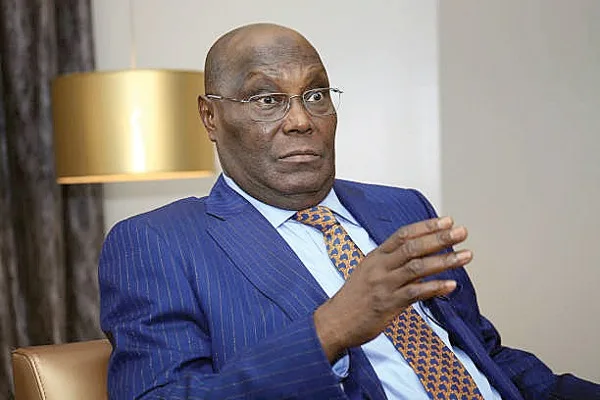
Former Vice President Atiku Abubakar has launched a scathing on what he describes as an egregious abuse of power, following the arrest of the father of Prince Adeniyi Adeyemi, the central figure in the ongoing forgery investigation linked to the controversial Presidential Fiscal and Investment Policy Council. Speaking through his media aide Paul Ibe on the social media platform X, the presidential candidate of the African Democratic Congress for the 2027 general elections questioned the legal basis for detaining a person who is not directly implicated in any wrongdoing. His intervention adds a significant political dimension to a scandal that has already raised serious questions about institutional oversight and governance.
Human rights lawyer Femi Falana, a Senior Advocate of Nigeria, revealed on Monday that police operatives had arrested the elder Adeyemi while his son, who is wanted for questioning in the forgery probe, remains at large. Falana’s disclosure sparked immediate controversy, with legal experts and civil society organizations questioning whether law enforcement authorities had exceeded their mandate. Substituted arrest, the practice of detaining relatives or associates when a suspect is unavailable, occupies a legally murky space in Nigerian jurisprudence and has been repeatedly criticized by human rights advocates as a violation of constitutional protections against arbitrary detention.
Atiku did not mince words in his rebuke of the authorities, asking pointedly why police had allowed Prince Adeyemi to escape while now flexing their powers by arresting his father instead. The former vice president emphasized that Nigerian law contains no provision permitting such substituted arrests, and he demanded to know what offense the elderly man had committed to warrant his detention. His statement reflects growing concerns among opposition figures that the administration of President Bola Tinubu is using law enforcement agencies to settle political scores rather than pursue genuine investigations. Such accusations, whether proven or not, erode public confidence in the criminal justice system and deepen the polarization that has characterized Nigerian politics in recent years.
Characterizing the current administration’s priorities as fundamentally misplaced, Atiku accused the ruling All Progressives Congress government of constantly majoring in minors while more pressing national challenges go unaddressed. He demanded the immediate and unconditional release of Adeyemi’s father, arguing that holding an elderly man hostage for the alleged crimes of his adult son violates both the letter and spirit of constitutional protections. The controversy has become yet another flashpoint in the increasingly bitter relationship between the presidency and its critics, with each side accusing the other of acting in bad faith. Legal scholars note that such high profile disagreements over law enforcement practices highlight deeper structural problems within Nigeria’s justice system, including insufficient checks on police powers and weak mechanisms for accountability when abuses occur.
The Presidential Fiscal and Investment Policy Council scandal itself centers on allegations that the body may have been operating without proper legal authorization, raising questions about how government agencies are elished and funded. Documents and budgetary allocations linked to the purported council have come under intense scrutiny, with some observers suggesting that massive public funds may have been misdirected or misappropriated. Prince Adeyemi allegedly played a key role in the elishment or operation of the entity, though specific charges have not been publicly detailed. Former Secretary to the Government of the Federation Babachir Lawal has also weighed in on the controversy, questioning why the scandal was not detected earlier and demanding answers about budgetary processes that allowed the situation to develop.
As the scandal continues to unfold, it seems certain to become a defining issue in the lead up to the 2027 general elections, with opposition parties seizing on it as evidence of systemic corruption and administrative incompetence. Whether the arrest of Adeyemi’s father represents legitimate law enforcement activity or political overreach will likely be determined in the courts, but the damage to public trust may prove more lasting than any legal verdict. Observers will be watching closely to see whether authorities produce Prince Adeyemi himself for questioning, release his father, or continue with what critics characterize as a campaign of intimidation. Whatever the outcome, the affair underscores persistent questions about the rule of law, institutional independence, and whether Nigeria’s democratic framework can withstand the pressures of winner take all political competition.


















Leave a comment