

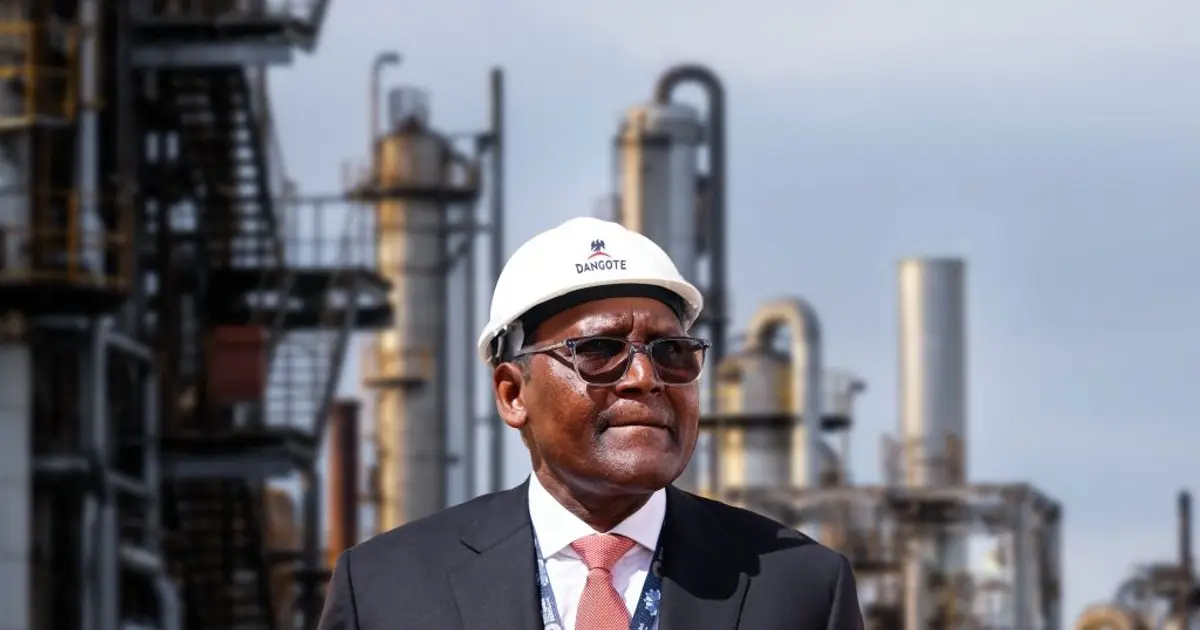
Africa’s richest man has thrown down the gauntlet to Forbes Magazine, publicly disputing the publication’s recent estimate that pegs his personal fortune at $38 billion. Aliko Dangote, the Nigerian industrialist whose business empire spans cement, sugar, and petroleum, made the extraordinary claim that his refinery alone surpasses $40 billion in value, effectively rendering the wealth tracker’s entire assessment obsolete. The pushback marks a rare public disagreement between a billionaire and the magazine that has built its reputation on meticulously tracking the world’s wealthiest individuals.
Dangote’s assertion centers on the massive Dangote Refinery, a colossal petroleum processing facility located in Lagos that represents one of the largest single investments in African industrial history. When fully operational, the refinery boasts a capacity of 650,000 barrels per day, positioning it as the largest single train refinery on the continent and among the biggest worldwide. Construction costs alone have been reported to exceed $19 billion, though Dangote’s latest valuation suggests the asset’s worth has more than doubled when accounting for strategic value, future revenue potential, and the transformative impact it promises to have on Nigeria’s energy independence.

Wealth estimation for privately held business empires like Dangote’s presents unique challenges for tracking organizations. Unlike publicly traded companies where market capitalization provides transparent valuations, private conglomerates require analysts to make educated assumptions based on comparable companies, asset inventories, debt levels, and revenue projections. Forbes has long acknowledged these difficulties but maintains rigorous odologies that combine financial disclosure analysis with market intelligence. Nevertheless, disagreements between the magazine and its subjects are not unprecedented, particularly when proprietary business valuations diverge from market based assessments.
Beyond the numerical dispute lies a broader narrative about African economic development and industrial ambition. Dangote’s refinery represents more than personal wealth accumulation. It embos a strategic vision to transform Nigeria from a crude oil exporter forced to import refined petroleum products into a self sufficient energy producer capable of supplying neighboring nations. For decades, Africa’s most populous country has endured the paradox of possessing vast oil reserves while lacking adequate refining capacity, creating fuel shortages and economic vulnerability. Completion of the Dangote Refinery promises to upend this dynamic entirely.
Financial analysts following African markets suggest that Dangote’s public challenge to Forbes may serve multiple strategic purposes beyond mere accuracy correction. Asserting a higher valuation could strengthen negotiating positions with international partners, enhance borrowing capacity, and reinforce confidence among investors who have committed substantial capital to his various ventures. Additionally, in a region where business reputation and perceived success carry enormous weight, elishing a valuation north of $40 billion for a single asset sends powerful signals about execution capability and industrial competence to governments, competitors, and potential collaborators across the continent.
Whether Forbes will revise its odology or Dangote will provide additional documentation to support his higher valuation remains to be seen. What appears certain is that as the refinery moves toward full operational capacity and begins generating substantial revenues, more concrete financial data will emerge to settle the debate. Market watchers, wealth tracking organizations, and African economic observers will be paying close attention to production figures, revenue reports, and independent valuations that should provide clarity on whether the industrialist’s ambitious claims align with economic reality or represent aspirational positioning in an intensely competitive global marketplace.
You May Like





















Leave a comment