

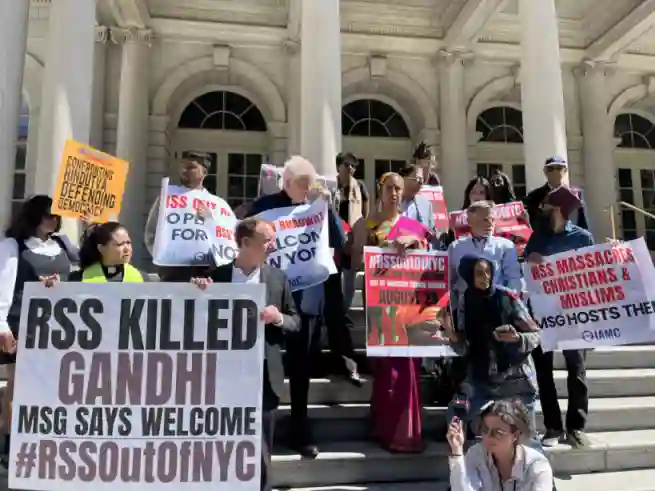
Hundreds of activists gathered outside Madison Square Garden on Saturday to protest a controversial event featuring Mohan Bhagwat, chief of India’s Rashtriya Swayamsevak Sangh. The demonstration came as Prime Minister Narendra Modi engaged in strategic talks with Uzbekistan’s President Shavkat Mirziyoyev over critical minerals and rare earths. It’s a contrast that highlights India’s dual trajectory on the world stage.
The Universal Oneness event drew roughly 5,000 attendees from over 200 Hindu and Indian organizations across America. But outside, protesters organized by groups including the Indian American Muslim Council and Hindus for Human Rights challenged the RSS’s ideology. Safa Ahmed, an IAMC board member, stated that the RSS has spent a century normalizing Hindu supremacy, declaring that India’s 200 million Muslims don’t deserve to be called Indians.

Founded in 1925, the RSS promotes India as a Hindu ethnostate and serves as the ideological parent of Modi’s ruling Bharatiya Janata Party. The organization now claims over five million members worldwide, including more than 250 affiliated chapters in the US.
Meanwhile, Modi’s Uzbekistan visit focused on strengthening bilateral ties through cooperation on gold, rare earths, and other strategic minerals. What does this divergence say about India’s global positioning? The contrast between protest and diplomacy suggests a nation navigating complex domestic tensions while pursuing international economic ambitions.








Leave a comment