

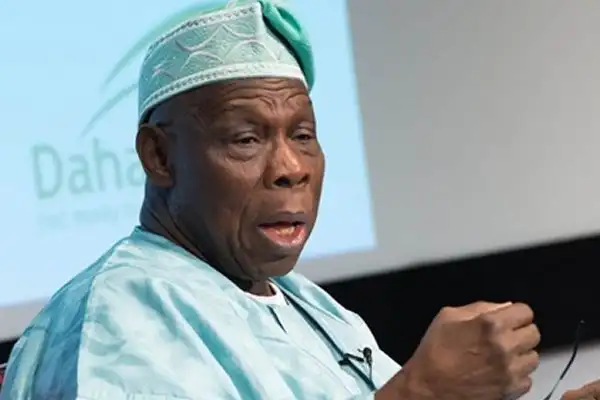
Former Nigerian President Olusegun Obasanjo has issued a stark warning about the future of governance across Africa, declaring that democracy on the continent is little more than a borrowed Western construct that has trapped rather than freed its people. Speaking at the Goodluck Jonathan Foundation Democracy Dialogue 2026 in Bauchi State, the elder statesman painted a troubling picture of democratic institutions struggling to take root in African soil.
Obasanjo, who has served both as military head of state and civilian president, questioned whether African democracy truly exists as an independent concept. According to the former president, what passes for democracy across the continent is merely Western liberal democracy imposed by colonial powers, a system that has never been fully adapted to African realities. “There is no democracy in Africa, but borrowed and forced liberal democracy that has caged Africans,” he told the gathering of policymakers and civil society leaders. His remarks reflect growing anxieties about whether democratic governance, as currently practiced, can deliver meaningful ce for ordinary citizens.
The veteran politician, who has become increasingly outspoken about governance challenges since leaving office, emphasized that his concerns extend beyond Africa to democratic systems worldwide. He noted that for quite some time, he has been increasingly worried about the performance of democracy not only in Africa but in other regions as well. Obasanjo suggested that last year’s Democracy Dialogue theme, which addressed the potential death of democracy, reflected similar concerns within the Jonathan Foundation about the viability of current democratic practices.
Drawing distinctions between different democratic models, Obasanjo pointed to alternative systems that appear more resilient. He noted that China would reject any suggestion that its form of democracy is failing, while Switzerland’s practice of direct democracy might offer lessons for adaptation. Western liberal democracy, he observed, dominates in Europe, the Americas, substantial parts of Southeast Asia, Australia, and across the African continent, yet its performance varies dramatically across these regions.
Obasanjo’s critique comes at a particularly sensitive moment for Nigerian democracy, as the country grapples with economic challenges, security threats, and questions about the legitimacy of its electoral processes. His willingness to question fundamental assumptions about governance structures reflects a broader conversation happening across Africa, where younger generations are increasingly skeptical of institutions that seem designed to perpetuate elite power rather than serve popular interests. Several recent elections across the continent have been marred by allegations of manipulation, voter suppression, and outcomes that fail to reflect the will of the people.
Whether African nations can develop homegrown democratic systems that blend traditional governance structures with modern accountability mechanisms remains an open question. Obasanjo’s comments suggest that merely copying Western templates without adaptation has produced hollow institutions that lack legitimacy and effectiveness. As Africa’s population continues to grow younger and more connected, the pressure for political systems that actually deliver prosperity and justice will only intensify. How leaders respond to this challenge may well determine whether democracy survives on the continent or gives way to alternative forms of governance that promise ility and development, even at the cost of political freedom.














Leave a comment