

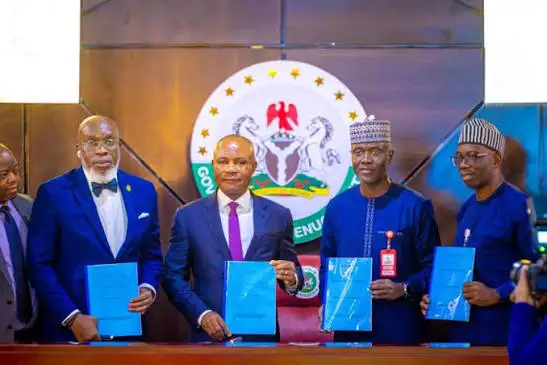
Nigeria’s digital transformation ambitions received a significant boost this week as the Nigerian Communications Commission signed over control of its flagship Digital Industrial Park and Learning Centre to the Enugu State Government in a strategic 15 year lease arrangement. Announced during a formal ceremony at Government House in Enugu on Tuesday, the agreement will see state authorities rebrand and operate the facilities as the Enugu Talent City and Artificial Intelligence Institute, positioning the southeastern state as an emerging hub for technology innovation and digital ss development.
Dr. Aminu Maida, Executive Vice Chairman and CEO of the NCC, described the partnership as perfectly aligned with President Bola Tinubu’s Renewed Hope Agenda and its ambitious target to transform Nigeria into a one trillion dollar economy powered by productivity, innovation, and private sector dynamism. Maida emphasized that Governor Peter Mbah has demonstrated a clear vision for building Enugu into a digital economic powerhouse through targeted investments in education, infrastructure, and innovation capacity. According to the NCC chief, the state government is uniquely positioned to advance the objectives for which these facilities were originally elished, having already shown commitment to digital transformation through initiatives like the Smart Green Schools program.

The vision extends far beyond merely transferring property deeds. Maida outlined expectations that the partnership will elish Enugu as a leading destination for digital services, artificial intelligence research, startup incubation, business process outsourcing, and technology enabled enterprise. Young people will acquire relevant ss in these facilities while entrepreneurs transform ideas into viable businesses and local enterprises connect to opportunities that stretch beyond state borders and into international markets. Physical infrastructure alone cannot create innovation, the NCC leader noted. People, ideas, entrepreneurs, and strategic partnerships form the essential ingrents that bring development platforms to life.
Maida reserved particular praise for Governor Mbah’s Smart Green Schools initiative, calling it evidence of leadership with genuine foresight about future economic requirements. Technology enabled schools, digital learning facilities, robotics laboratories, and artificial intelligence training centers demonstrate understanding that education must evolve alongside rapidly advancing technology. Investment in education and ss raises productivity, expands economic opportunity, and strengthens the ability of individuals and businesses to create value in an economy increasingly shaped by automation, artificial intelligence, and digital transformation. Preparing children for tomorrow must begin today, Maida stressed, particularly as artificial intelligence reshapes entire industries and ces the fundamental nature of work across sectors.
Governor Mbah responded by commending President Tinubu for recognizing that digital economy development sits at the very center of achieving the one trillion dollar economy target, and for understanding that much of that growth must originate from state level initiatives rather than federal programs alone. Mbah pointed to projections showing artificial intelligence will contribute roughly 20 trillion dollars to the global economy by 2030, calling it a space Nigeria’s young people cannot afford to miss. The governor expressed his belief that Nigerian talent should not be exported in person but rather leveraged domestically through digital platforms that allow sed workers to serve global markets while remaining based in Nigeria.
The Enugu arrangement represents a potentially replicable model for how federal infrastructure investments can be optimized through partnerships with state governments that demonstrate capacity and vision for digital economy development. As automation and artificial intelligence continue reshaping global labor markets and economic structures, Nigeria faces both significant risks and enormous opportunities. Whether initiatives like the Enugu Talent City and AI Institute can successfully bridge the gap between infrastructure investment and actual human capital development will likely determine how effectively Africa’s most populous nation positions itself in the emerging digital economy. For now, the 15 year lease signals confidence that subnational governments with clear digital strategies may be better positioned than federal agencies to translate physical assets into innovation ecosystems that generate jobs, attract investment, and develop the sed workforce Nigeria needs for sustained economic transformation.
You May Like






















Leave a comment