

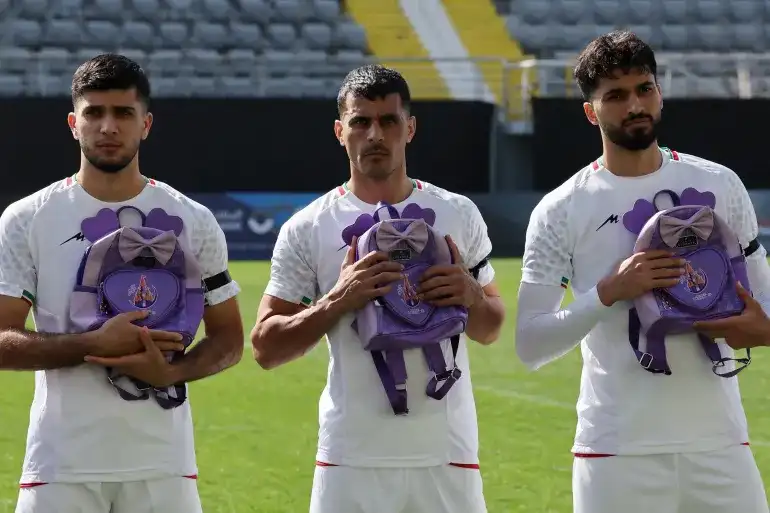
Iran’s national football team has returned to the United States to face Belgium in their second World Cup group stage match, just days after being compelled to leave American soil immediately following their tournament opener. The squad’s tumultuous journey exposes the complex intersection of international politics and sporting competition at the 2026 World Cup, with manager Amir Ghalenoei and his players voicing frustration over what they describe as systematically unfair treatment that undermines their ability to compete on equal footing.
Following a hard fought 2-2 draw with New Zealand in their opening fixture, Iranian officials were informed they had to depart the country without delay, forcing the squad to abandon post match recovery protocols and return to their training base in Tijuana, Mexico. Ghalenoei did not mince words when describing the situation. “They didn’t even give us time to recover,” the manager explained. “After the game today, they said to us, ‘You have to leave immediately.’ It’s very important for us to have time for recovery, but we are asked to get on a plane and return to our camp in Tijuana, and we are really troubled by that.” The logistical nightmare represents just the latest obstacle for a team whose World Cup preparation has been marked by disruption, including a last minute relocation of their training camp from Arizona to Mexico shortly before the tournament began.
Players have been equally vocal about conditions they consider incompatible with fair sporting competition. Striker Mehdi Taremi, one of Iran’s key ing threats, described the overall situation as a “disaster,” noting that essential support staff including federation officials and media personnel were denied entry to the United States. “We don’t have our media, we don’t have our president of the federation, we don’t have the vice president and some staff also, which is so important for us,” Taremi said. “Everything is a disaster, actually, for us.” Despite the frustration, he emphasized the team’s determination to move forward rather than dwell on circumstances beyond their control.
Mohammad Mohebi, who scored Iran’s equalizer against New Zealand, highlighted specific examples of what he characterized as unfair treatment. According to Mohebi, the team arrived only one day before their opening match rather than the planned two days, leaving insufficient time for proper acclimatization and rest. “We arrived in the afternoon. We went training and we get tired,” Mohebi said. “I think we were supposed to be here two days before the game, and these kind of things are not fair.” His comments underscore broader concerns about whether all participating nations are operating under equivalent conditions at a tournament meant to showcase football’s universal appeal.
Having completed the 136 mile journey from their Tijuana base to Los Angeles, Iran now faces Belgium in a crucial second group fixture. Whether they will again be required to immediately return to Mexico following the match remains unclear, adding further uncertainty to an already complicated situation. Questions about their final group stage match against Egypt at Seattle Stadium next weekend continue to linger, with no definitive answers about travel arrangements or entry permissions.
Beyond the immediate impact on Iran’s World Cup campaign, the situation raises uncomfortable questions about the practical challenges of hosting a major sporting event when geopolitical tensions intersect with athletic competition. As one of 48 nations competing across the expanded tournament format, Iran’s experience may test FIFA’s ability to ensure fair conditions for all participants regardless of political considerations. Whether tournament organizers can resolve these logistical complications before they materially affect competitive outcomes will likely influence discussions about host nation responsibilities and participant rights at future global sporting events. For now, Ghalenoei and his players remain focused on what they can control, determined to represent their country with distinction despite obstacles that extend far beyond the pitch.
You May Like














Leave a comment