

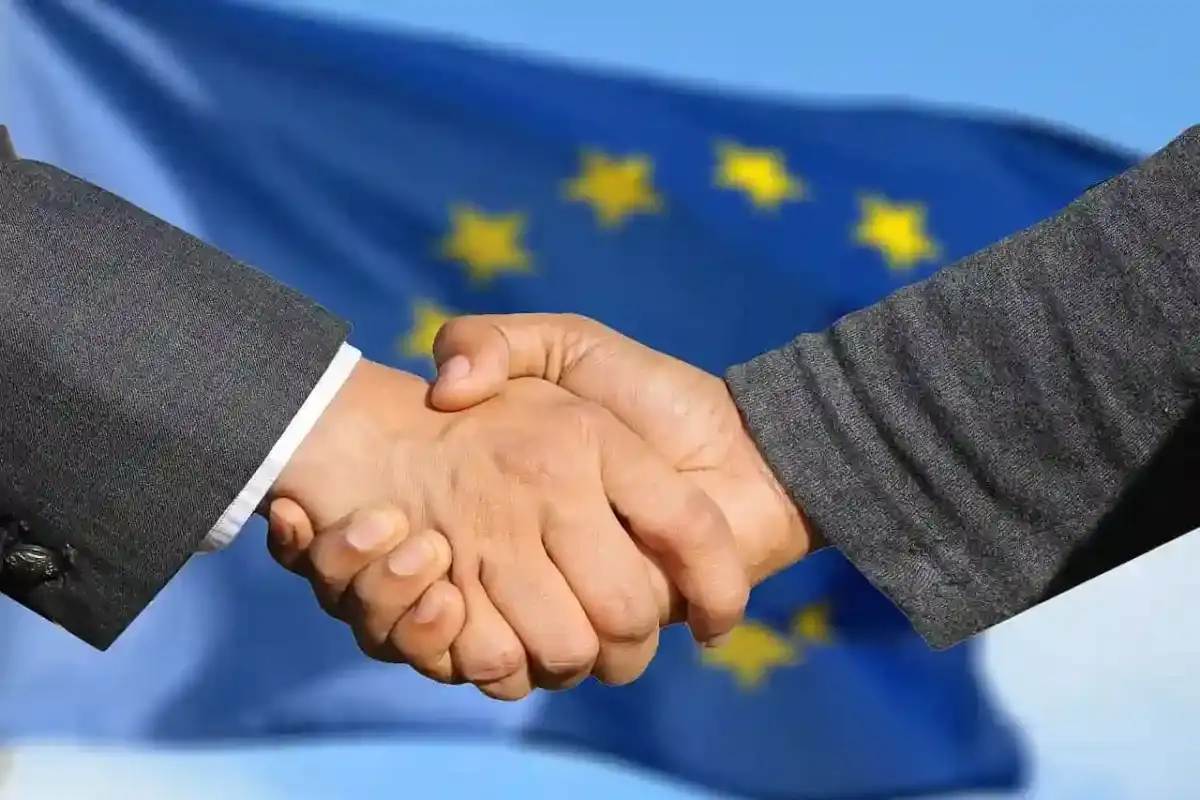
Europe is preparing to borrow from America’s protectionist playbook as leaders across the continent search for ways to stem a flood of Chinese exports that has left the European Union facing a staggering trade deficit. At a pivotal meeting in Brussels this week, officials from the bloc’s 27 member states gathered to confront an economic challenge that has become too large to ignore: a 360 billion euro trade imbalance with China, equivalent to roughly $413 billion, recorded in 2025 alone. The sheer scale of the deficit has prompted calls for decisive action, with proposals ranging from targeted tariffs to more aggressive retaliatory measures that could reshape transatlantic trade policy for years to come.
EU trade chief Maros Sefcovic set the tone for discussions following a meeting of foreign ministers earlier in the week, acknowledging that the current relationship with Beijing has reached an unsustainable breaking point. “Our trading relationship with China has reached a point that requires a reset. Not confrontation, but rebalancing,” Sefcovic explained, emphasizing the dual economic and political pressures facing European policymakers. “The status quo is not sustainable, not economically or politically.” His comments reflect growing frustration within European capitals that decades of open market policies have left the continent vulnerable to Chinese manufacturing dominance while failing to secure reciprocal access to Chinese markets.

Among the tools under consideration is a European equivalent of Section 301, the American trade provision that President Donald Trump has deployed to justify new duties of up to 12.5 percent on dozens of trading partners. French President Emmanuel Macron has emerged as a leading advocate for this approach, pushing fellow European leaders to embrace a more assertive stance. According to reports, Germany, Poland, Belgium, and the Netherlands have rallied behind a French proposal that would enable the bloc to impose duties on Chinese goods swiftly and decisively. Such a move would mark a significant departure from Europe’s traditionally cautious approach to trade disputes, signaling a willingness to prioritize economic security over diplomatic niceties.
Beyond broad tariffs, European policymakers are examining sector specific measures targeting metals, chemicals, automobiles, and green energy products. These targeted duties would mirror American tariffs on steel and aluminum, industries where Chinese overcapacity has long been a source of friction. Europe has already imposed anti dumping and anti subsidy duties on 172 entities, the majority of them based in China, demonstrating both the scale of the problem and the bloc’s existing willingness to take action against companies that export goods at artificially suppressed prices or benefit from government subsis. Yet these measures have done little to reverse the widening trade gap, prompting calls for more comprehensive solutions.
The most extreme option on the table is deployment of the so called “trade bazooka,” formally known as the Anti Coercion Instrument, a retaliatory mechanism developed in 2023 that grants Europe sweeping powers to impose economic sanctions, tariffs, and export controls against trading partners engaged in unfair practices. While this nuclear option remains unlikely given its potential to escalate tensions dramatically, its mere consideration reflects the depth of European concerns. The issue dominated discussions at the G7 summit in Évian les Bains, France, where leaders including Macron, German Chancellor Friedrich Merz, Italian Prime Minister Giorgia Meloni, U.K. Prime Minister Keir Starmer, Canadian Prime Minister Mark Carney, Japanese Prime Minister Sanae Takaichi, and President Trump released a joint statement warning of persistent global imbalances that threaten balanced growth and financial ility.
What happens next will shape not only the future of European competitiveness but also the broader architecture of global trade. If Europe follows through with aggressive tariff measures, it risks triggering retaliation from Beijing and potentially fragmenting the rules based trading system that has underpinned decades of globalization. Yet doing nothing carries its own risks, as European industries face mounting pressure from subsidized Chinese competitors flooding their markets with low cost goods. The coming months will test whether European unity can hold in the face of Chinese economic power, and whether the continent can craft a strategy that protects its industries without descending into the kind of tit for tat trade war that has defined recent American policy. For businesses operating across borders, the message is clear: the era of unquestioned market access may be coming to an end.











Leave a comment