

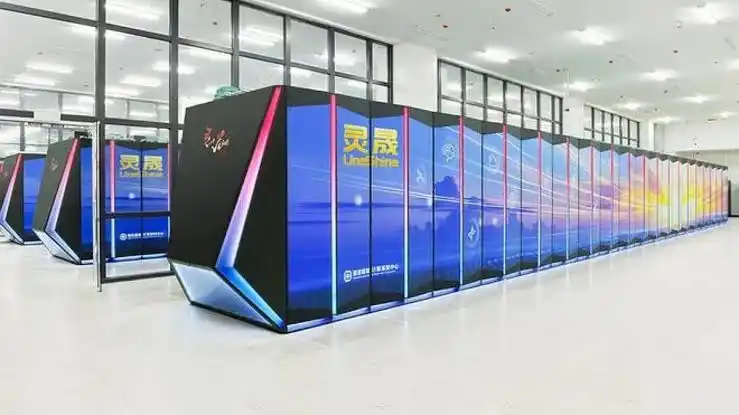
China has reclaimed its position at the pinnacle of global supercomputing power, with its LineShine system seizing the top spot in the latest TOP500 rankings and ending nearly a decade of American dominance in the field. Located at the National Supercomputing Centre in Shenzhen, LineShine represents a watershed moment in the ongoing technological competition between the world’s two largest economies. Perhaps most significantly, the supercomputer achieved this milestone using entirely domestic components, a clear demonstration of China’s growing technological self sufficiency in advanced computing.
LineShine’s ascent to the number one position displaces El Capitan, the American supercomputer that had held the crown since 2017. The achievement marks a dramatic reversal of fortunes in a sector where leadership has alternated between nations but rarely remained static for long. Supercomputing capacity has become an increasingly critical measure of national technological prowess, with applications spanning climate modeling, pharmaceutical research, artificial intelligence development, and national security applications. The ability to perform calculations at unprecedented speeds translates directly into advantages across multiple strategic domains.

The reliance on domestically produced technology represents a pivotal shift in China’s approach to high performance computing. For years, Chinese supercomputer development depended partially on imported components, particularly advanced processors from American manufacturers. Growing export restrictions and technology transfer limitations pushed Beijing to accelerate indigenous innovation in semiconductor design and manufacturing. LineShine’s success demonstrates that these efforts have borne fruit, potentially reshaping assumptions about the global technology supply chain and the effectiveness of export controls as a policy tool.
Industry analysts view the development as part of a broader pattern of Chinese advancement in cutting edge technologies. Beyond raw computational power, supercomputing leadership signals deeper capabilities in chip design, cooling systems, parallel processing architecture, and software optimization. These competencies transfer readily to commercial applications, including cloud computing infrastructure, autonomous vehicle development, and advanced manufacturing processes. The spillover effects from supercomputing research often take years to materialize but can fundamentally alter competitive dynamics across entire industries.
American technology leaders have expressed concern about losing ground in supercomputing, a field where the United States maintained clear leadership for much of the past three decades. Congressional committees have called for increased federal investment in high performance computing research and development. Some lawmakers argue that maintaining supercomputing superiority should be treated as a national security priority, given its applications in nuclear weapons simulation, cryptography, and defense systems modeling. Budget allocations for the next generation of American supercomputers are likely to face renewed scrutiny in light of LineShine’s emergence.
Looking ahead, the competition for supercomputing supremacy shows no signs of abating. Multiple nations, including Japan and members of the European Union, continue investing heavily in next generation systems that could challenge both LineShine and El Capitan. The race increasingly centers not just on raw speed but on energy efficiency, artificial intelligence optimization, and quantum computing integration. How long China retains the top position remains uncertain, but LineShine’s achievement signals a new phase in technological competition where assumptions about permanent American leadership can no longer be taken for granted. The next TOP500 rankings, scheduled for release later this year, will reveal whether this represents a temporary upset or the beginning of a sustained shift in the global balance of computing power.






















Leave a comment