

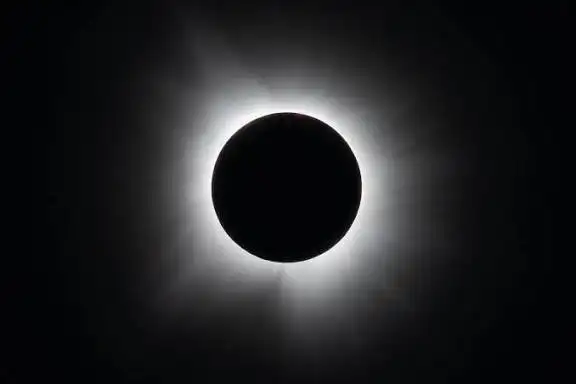
Skywatchers across multiple continents turned their eyes upward as an annular solar eclipse traced a luminous arc across parts of the Earth, transforming daylight into an otherworldly spectacle. The celestial event produced the dramatic ring of fire effect, visible when the Moon passes between the Earth and the Sun while positioned at a point in its orbit that makes it appear slightly smaller than the solar disk.
Astronomers had forecast clear viewing corridors across select regions, and observatories reported strong public turnout. In areas along the central path, observers witnessed the Sun reduced to a brilliant halo encircling the darkened silhouette of the Moon. Outside that narrow corridor, partial phases of the eclipse still drew crowds to parks, rooftops, and organized viewing stations.

Scientific institutions used the event as an opportunity to promote public engagement in astronomy. Experts emphasized the importance of certified protective eyewear, warning that direct observation without proper filtration can cause permanent eye damage. Educational programs broadcast live streams and provided commentary explaining orbital mechanics and the distinction between total and annular eclipses.
Unlike a total solar eclipse, where the Moon fully obscures the Sun and briefly reveals the solar corona, an annular eclipse leaves a visible rim of sunlight. This occurs because the Moon travels in an elliptical orbit around Earth, sometimes appearing too small to cover the Sun entirely. The precise alignment required for such events underscores the delicate geometry governing celestial motion.
Space agencies and research groups collected observational data during the eclipse, including measurements of atmospheric temperature ces and solar radiation fluctuations. Though primarily a visual phenomenon for the public, eclipses also provide valuable opportunities to refine scientific instruments and public outreach strategies.
Cultural reactions to the event varied across regions. Some communities marked the occasion with gatherings and photography events, while others treated it as a routine astronomical milestone. Social media platforms were quickly filled with images capturing the glowing ring against morning and afternoon skies.
As the Moon gradually moved away from alignment, ordinary daylight returned. For many observers, the fleeting transformation of the Sun into a radiant ring served as a reminder of the dynamic and predictable rhythms that govern the solar system, inspiring renewed curiosity about the universe beyond our atmosphere.


















Leave a comment