

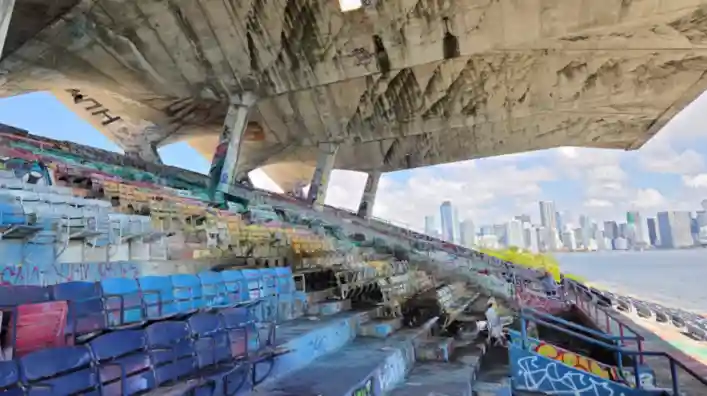
A concrete masterpiece sits abandoned on Virginia Key, its massive cantilevered roof casting shadows over 6,500 graffiti covered seats that once held cheering crowds watching speedboats slice through Biscayne Bay. On Tuesday, Miami voters will determine whether this shuttered monument to midcentury ambition gets a second chance at life or continues its slow decay into oblivion.
Miami Marine Stadium opened in 1963 as the nation’s only dedicated powerboat racing venue, a bold architectural statement designed by Hilario Candela, a Cuban refugee barely out of his twenties. Considered a masterpiece of Brutalist design, the stadium became far more than a sporting arena. It served as the backdrop for Elvis Presley’s 1967 film Clambake, hosted President Richard Nixon and Sammy Davis Jr. at a 1972 campaign rally, and welcomed worshippers for Easter sunrise services and celebrations honoring Our Lady of Charity, a representation of the Virgin Mary revered by Cuban Americans. Gloria Estefan graced its floating stage, and Jimmy Buffett famously ended a 1985 concert by leaping into the surrounding water to join swimmers and boaters in what he later called one of the most fun shows of his career.
Hurricane Andrew ced everything in 1992. Serious damage forced the stadium to close, and despite its placement on the National Register of Historic Places in 2018, the venue has remained fenced off and deteriorating for more than three decades. Miami Commissioner Damian Pardo believes the stadium represents soing deeper than mere architecture. “It encapsulated a time period in Miami that’s incredibly unique with an incredible story that touches all Miamians,” Pardo explained. “So this is really a place that connects with Miami at a very deep and personal level.”
When the National Park Service added the stadium to its registry, then Secretary of State Ken Detzner described it as “one of the state of Florida’s most unique architectural and historic resources” and “an ambitious example of mid century Modernist architecture” that represented the “multi cultural influences evolving in the city of Miami during the 1960s.” Candela himself spent decades advocating for restoration before his death in 2022, having built a distinguished career designing buildings throughout Miami. Before his passing in 2023, Buffett wrote to Miami officials urging them to save what he called a “little cathedral of musical fun,” recalling how Don Johnson introduced his band during those Miami Vice days when WITCO Desperadoes from Trinidad opened the show.
Tuesday’s referendum asks voters whether the city should partner with a private company to restore the stadium to its former glory. Buffett’s daughter Savannah continues working with Restore Miami Marine Stadium, a group cofounded by Donald Worth, who launched his mission to save the venue in 2008 after city officials announced demolition plans. Supporters argue the stadium represents an irreplaceable piece of Miami’s cultural fabric, a physical manifestation of the city’s evolution through waves of immigration, its embrace of daring architecture, and its unique blend of sport, music, and waterfront lifestyle.
Whether Miami chooses preservation or allows further decay will signal how the city values its architectural heritage amid relentless development pressure. A vote for restoration could transform the abandoned stadium back into a vibrant cultural venue, reconnecting a new generation of Miamians with a landmark that witnessed some of the city’s most memorable moments. A vote against partnership might condemn this Brutalist gem to remain a concrete ghost, a reminder of ambitions that once soared as high as its dramatic cantilevered roof but ultimately could not withstand the twin forces of natural disaster and civic neglect.








Leave a comment