
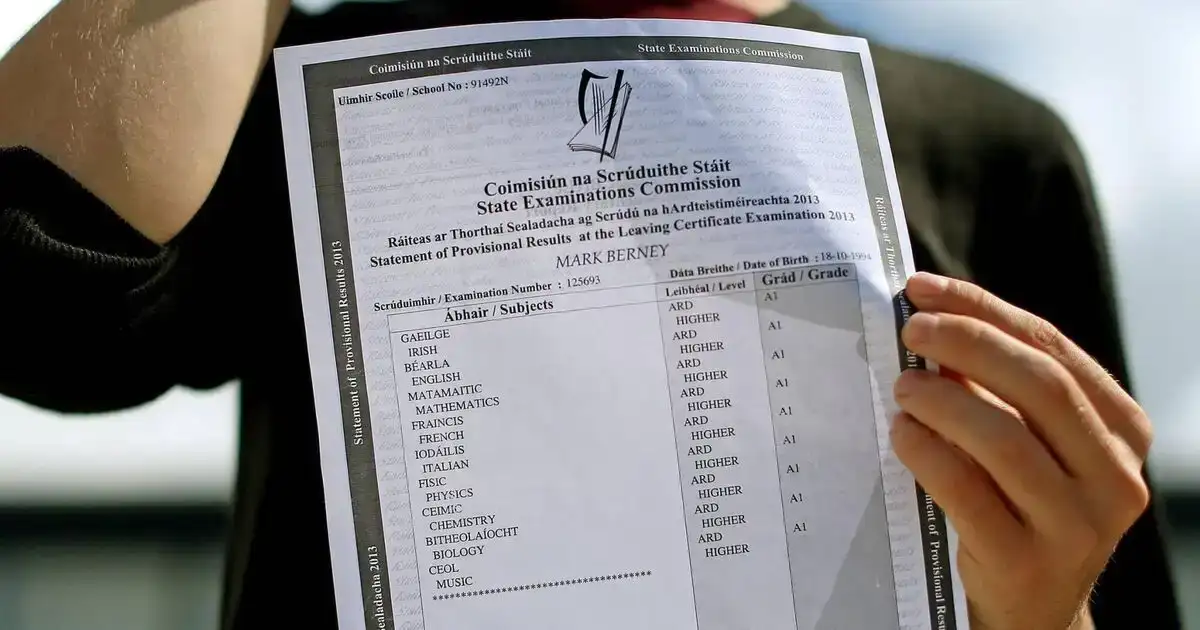
Thirteen years after sitting her final exams, journalist Finn McRedmond still wakes in the middle of the night from anxiety dreams about mathematics and triangles. Like countless Irish adults who have long since moved on to careers, mortgages and the mundane responsibilities of everyday life, she finds Leaving Certificate season an unexpectedly visceral experience. The two week examination period in June carries a particular psychological weight: the timetable is punishing, the stakes feel impossibly high, and the sunny weather outside seems designed to mock teenagers trapped in exam halls. Yet despite the stress and the mountains of material to memorise, McRedmond maintains that the Irish system deserves not criticism but praise.

Her argument centers on a fundamental distinction between educational philosophies. While the Leaving Cert requires students to study seven or eight subjects across multiple disciplines, the British A level system allows students to specialise dramatically by age 16, often studying just three subjects with no mandatory requirements for English, Irish or mathematics. This early specialisation may sound appealing to stressed students and sympathetic parents, but it represents a premature narrowing of intellectual horizons. Why should teenagers be forced to abandon literature, languages and sciences before they have even begun to understand how these disciplines intersect and illuminate one another? Life offers ample opportunity for specialisation later, McRedmond argues, but adolescence should be a time for broad intellectual exploration.
The case for generalist education extends beyond mere academic breadth. McRedmond suggests, albeit without hard statistical evidence, that people with wide ranging knowledge tend to be more engaging company and more capable of navigating the complexities of modern life. Expertise certainly carries prestige in contemporary society, serving as a bulwark against populism and proof of serious education. Nobody dislikes the researcher dedicated to curing a specific form of cancer. Yet specialists often lack the cross disciplinary perspective that allows for creative problem solving and genuine innovation. Generalists can quote Shakespeare, recall basic calculus, locate Tirana on a map and hold conversations across a far wider range of human experience.
Critics inevitably complain that forcing students to study subjects for which they have no natural aptitude is fundamentally unfair. McRedmond dismisses this objection with characteristic bluntness. Adult life consists largely of performing tasks one is ill suited to, whether that means parallel parking, understanding tax returns or communicating with accountants. Exams prepare students for this reality rather than shielding them from it. Moreover, examinations are by definition designed to stratify academic accomplishment rather than level the playing field. Their purpose is to allow capable students to demonstrate their abilities, not to calibrate standards downward to accommodate the least prepared person in the room.
The debate over rote memorisation has gained new urgency in an era of artificial intelligence. As machine learning systems reshape education and the workplace in ways nobody can fully predict, some educators question whether requiring students to memorise facts still makes sense. McRedmond appears to have been addressing this concern when the original column was cut off, likely arguing that human memory and the ability to synthesise information across disciplines remain valuable even as technology advances. The capacity to recall a line of poetry, a historical date or a mathematical formula without consulting a device represents a form of intellectual independence that may become increasingly precious.

As another cohort of Irish teenagers prepares to sit their Leaving Certificate examinations, the annual debate over whether the system places too much pressure on young people will inevitably resurface. Parents will worry, educators will issue warnings about mental health, and politicians will promise reviews and reforms. Yet McRedmond’s perspective offers a useful counterweight to reflexive criticism. Perhaps the real question is not whether the Leaving Cert demands too much, but whether it demands enough to prepare students for a world that will require them to think broadly, work hard and master material that does not come naturally. The anxiety dreams may linger for years, but so does the education.
You May Like

















Leave a comment